| Material Grade | Select the grade according to corrosion exposure, temperature, and forming requirements. | 304/304L: general food, architectural, and indoor applications.
316/316L: chloride, coastal, marine, and chemical environments.
201: lower-cost applications with limited corrosion exposure. | Material test certificate, heat number, chemical composition, and mechanical test results. | Prefer verified grade traceability |
| Applicable Product Standard | The quotation should state the exact product and testing standard rather than only “industrial quality.” | Common standards include ASTM A554 for welded ornamental tubing, ASTM A312 for seamless or welded pressure pipe, and EN 10217-7 for welded stainless steel tubes. | Standard designation, inspection plan, test method, and certificate of conformity. | Match the standard to the end use |
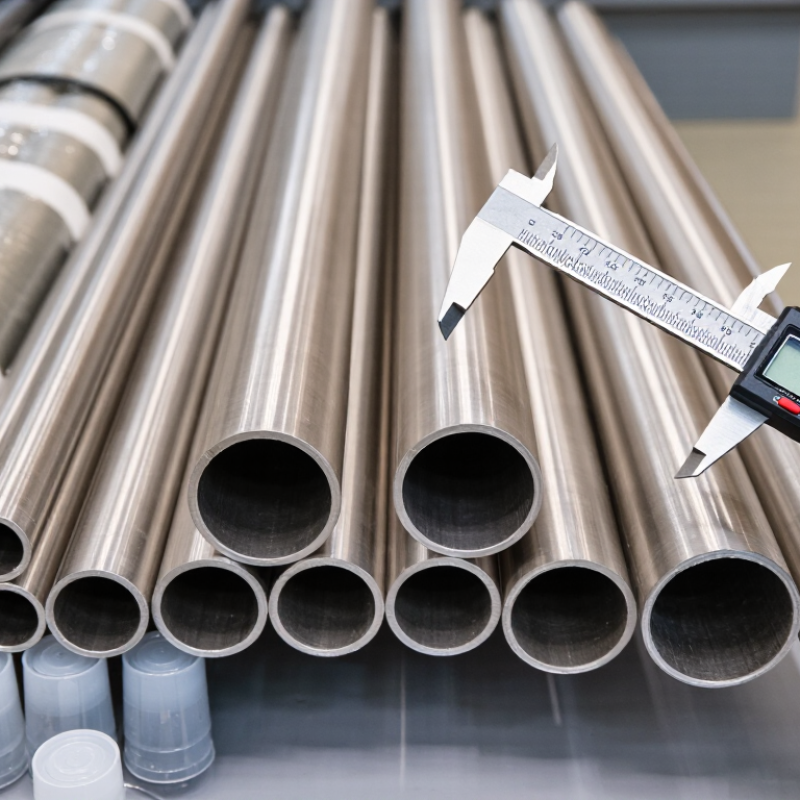
| Outside Diameter | Confirm outside diameter, wall thickness, length, and dimensional tolerance as separate items. | Common round-tube sizes range from approximately 6 mm to 219 mm outside diameter, depending on the production route and standard. | Dimension table, calibrated inspection records, and sample measurement report. | Reject quotations that give only a nominal size without tolerances. |
| Wall Thickness | Choose thickness based on pressure, structural load, corrosion allowance, and fabrication method. | Typical commercial ranges are approximately 0.5–6.0 mm for many decorative or general-purpose tubes; heavier walls may require specialized production. | Actual wall-thickness readings at multiple points around the circumference. | Verify minimum wall, not only average wall |
| Dimensional Tolerance | Use the tolerance specified by the applicable ASTM, EN, or project standard. | For many stainless tube standards, diameter and wall-thickness tolerances are commonly expressed as percentage limits; the exact value depends on size, manufacturing route, and standard. | Standard-based tolerance table and final inspection report. | Include tolerance requirements in the purchase order. |
| Manufacturing Route | Choose welded or seamless construction according to application and budget. | Welded: generally more economical and widely available in decorative and general industrial sizes.
Seamless: preferred for some high-pressure, high-temperature, or demanding service applications. | Production process statement, weld inspection method, and applicable process qualification records. | Do not pay for seamless unless the application requires it |
| Surface Finish | Specify finish by recognized designation and define the required appearance. | Common finishes include 2B for general industrial use, BA for a bright reflective surface, No. 4 brushed finish, and polished finishes commonly identified by grit such as 180 or 240. | Finish sample, surface roughness requirement where relevant, and approved reference sample. | Use a physical sample for visible architectural or consumer-facing work. |
| Corrosion Resistance | Evaluate grade, surface condition, passivation, environment, and cleaning practices together. | 316L generally provides better resistance to chloride-containing environments than 304L because of its molybdenum content; neither grade is universally corrosion-proof. | Chemical composition, passivation statement, salt-spray or corrosion test report when contractually required. | Use 316L for higher chloride exposure |
| Mechanical Properties | Confirm tensile strength, yield strength, elongation, and hardness against the selected standard. | Typical minimum values vary by grade and standard. For annealed 304/304L and 316/316L products, tensile strength is commonly specified around 485 MPa or higher, but the governing standard must control. | Heat-specific mechanical test results and third-party inspection report where needed. | Do not compare mechanical values from different standards without checking test conditions. |
| Price Structure | Compare total landed cost rather than the quoted tube price alone. | Main cost elements are stainless coil or billet price, grade surcharge, forming and finishing, cutting, packing, inspection, inland transport, ocean or air freight, duties, and local delivery. | Itemized quotation in USD or EUR, Incoterm, validity period, surcharge basis, and packing cost. | Require an itemized landed-cost comparison |
| Weight Calculation | Use theoretical weight to check whether the quoted quantity is reasonable. | Approximate stainless tube weight: kg/m = 0.02491 × wall thickness × (outside diameter − wall thickness), with dimensions in millimeters. Actual weight can vary because of tolerances and finishing. | Piece weight, total net weight, packing list, and actual weighing record. | Use actual packing-list weight for freight and customs planning. |
| Minimum Order Quantity | Confirm whether the order is made from regular stock or requires a new production run. | Stock lengths may be available in small quantities; custom sizes, special finishes, and non-standard grades commonly require higher minimum quantities. | Stock confirmation, production MOQ, setup charge, and leftover-material policy. | Request a stock option when the project quantity is small or urgent. |
| Standard Length | State fixed length, random length, or cut-to-length tolerance. | Common commercial supply includes 6 m fixed lengths, while other lengths may be available by agreement. Cut lengths can generate additional scrap and processing costs. | Length schedule, cutting tolerance, bundle quantity, and end-protection specification. | Optimize cutting plans before ordering to reduce waste. |
| Quality Inspection | Inspection should cover chemical composition, dimensions, surface, weld condition, and packaging. | Depending on the standard and use, tests may include hydrostatic or pneumatic testing, eddy-current testing, visual inspection, flattening, flaring, tensile, and hardness tests. | Inspection and test plan, mill certificate, non-destructive testing report, and pre-shipment inspection report. | Use third-party inspection for high-value or critical orders |
| Traceability | Every bundle and certificate should be traceable to the same heat or production batch. | Traceability should connect the heat number, tube bundle, test certificate, inspection record, and shipping documents. | Heat-number marking, bundle labels, certificate, and traceability matrix. | Make traceability a contractual requirement for industrial projects. |
| Packaging and Loading | Packaging should prevent scratches, deformation, moisture damage, and mixed-bundle errors. | Typical protection may include end caps, paper or plastic wrapping, steel or wooden bundling, moisture protection, and container bracing. | Packing specification, loading photographs, bundle dimensions, and gross/net weight list. | Specify whether plastic, wooden, or fumigated packaging is required for the destination country. |
| Delivery Lead Time | Separate production time from transit time and customs clearance. | Stock orders may ship in days to a few weeks; custom production commonly requires several weeks. Ocean transit and destination clearance must be added separately. | Production schedule, estimated ship date, transit route, booking plan, and delay-notification procedure. | Use milestone dates instead of one broad delivery promise |
| Incoterms and Payment | Compare quotations only after aligning the Incoterm, destination, currency, and payment basis. | Common terms include EXW, FCA, FOB, CIF, and DAP. Each term allocates freight, insurance, export handling, import clearance, and risk differently. | Pro forma invoice, Incoterms 2020 reference, payment schedule, bank details, and responsibility matrix. | For a fair comparison, calculate the delivered cost to the same named destination. |
| Supplier Qualification | Evaluate production capability, export experience, financial stability, and complaint handling. | A practical review should include factory audit results, equipment list, quality-system certification, sample performance, on-time delivery history, and corrective-action response. | Audit checklist, valid management-system certificate, references without confidential commercial data, and corrective-action records. | Select the supplier with the best verified total value |



 08045479132
 Send Inquiry

 Send Inquiry
 Send SMS