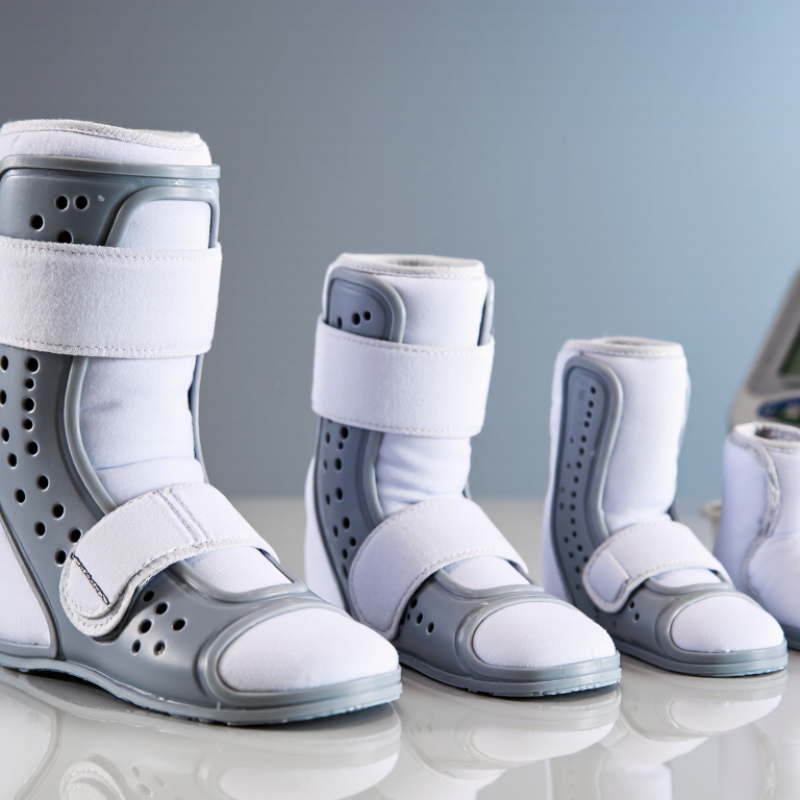
| Structural support frame | Polypropylene, polyethylene, or glass-fiber-reinforced polymer | Low density, moldability, impact resistance, and controlled stiffness | Anatomically contoured sidewalls; rounded edges; open heel or low-profile geometry where appropriate | Dimensional accuracy, absence of sharp edges, consistent wall thickness, and resistance to cracking during repeated flexing |
| Padding and skin-contact layer | EVA foam, polyurethane foam, spacer fabric, or breathable textile laminates | Cushioning, pressure distribution, moisture management, and comfort during extended wear | Removable or replaceable pads; ventilation zones; smooth seams; pressure-relief areas around malleoli | Uniform foam thickness, secure bonding or stitching, low surface abrasion, and resistance to compression set |
| Straps and fastening system | Nylon or polyester webbing with hook-and-loop fasteners; thermoplastic buckles where required | Tensile strength, abrasion resistance, adjustability, and repeated fastening performance | Cross-over straps, wide load-distribution zones, one-handed adjustment, and clearly defined strap routing | Stitch strength, fastening-cycle durability, strap slippage, edge fraying, and secure attachment to the shell |
| Stabilizing hinges or motion-control elements | Polymer hinge components, stainless-steel pins, or lightweight aluminum parts | Controlled range of motion, wear resistance, corrosion resistance, and mechanical stability | Medial and lateral support; optional motion stops; low-profile hinge covers to reduce snagging | Smooth movement, pin retention, absence of excessive play, corrosion checks, and repeat-cycle testing |
| Footbed and sole interface | EVA, polyurethane, rubber, or textured thermoplastic elastomer | Shock absorption, slip resistance, flexibility, and compatibility with footwear | Contoured foot platform, textured outsole, heel stabilization, and reduced bulk under footwear | Slip-resistance assessment, bonding strength, outsole wear, dimensional stability, and floor-contact uniformity |
| Anatomical fit and sizing | Size ranges based on foot length, ankle circumference, or user-specific measurement charts | Consistent fit, pressure distribution, and compatibility with different ankle profiles | Left/right configurations where needed; contoured heel cup; adjustable circumference; clear size markings | Fit trials across the declared size range, measurement repeatability, and verification of left/right orientation |
| Breathability and thermal comfort | Perforated polymer panels, 3D spacer mesh, moisture-wicking polyester, and ventilation channels | Air permeability, moisture transport, reduced heat accumulation, and improved wear comfort | Ventilated shell sections, mesh panels, open heel design, and moisture-resistant removable liners | Vent opening consistency, textile colorfastness, odor control, cleanability, and material compatibility |
| Skin safety and material selection | Skin-contact textiles, medical-use foams, non-latex elastic components, and corrosion-resistant hardware | Low irritation potential, cleanability, durability, and suitability for prolonged contact | Minimal exposed hardware; covered seams; smooth contact surfaces; removable washable liners | Biocompatibility evaluation appropriate to intended use, chemical screening, odor inspection, and residue control |
| Cleaning and maintenance | Washable polyester, polyurethane-coated textiles, corrosion-resistant fasteners, and nonabsorbent polymers | Resistance to mild detergents, moisture, repeated drying, and routine handling | Tool-free pad removal; washable straps; drainage or ventilation openings; concise care instructions | Material change after cleaning cycles, color transfer, fastener function, corrosion, and adhesive degradation |
| Manufacturing process control | Injection molding, thermoforming, die cutting, sewing, ultrasonic welding, and adhesive bonding | Repeatable geometry, stable assembly quality, efficient production, and traceable inspection | Defined process parameters, standardized jigs, controlled trimming, and documented assembly instructions | Incoming-material inspection, first-article approval, in-process checks, final inspection, and batch traceability |
| Packaging and global shipment readiness | Recyclable carton, protective tissue or polybag, printed instructions, and moisture-resistant secondary packaging | Protection from deformation, contamination, moisture, and abrasion during storage and transportation | Size and side identification; barcode or lot field; multilingual labeling; compact nested packing where suitable | Drop and compression checks, label accuracy, carton integrity, lot identification, and packaging cleanliness |
| Regulatory and documentation readiness | Technical drawings, bill of materials, risk documentation, inspection records, and user instructions | Supports product consistency, market-specific conformity assessment, and post-market traceability | Documented intended use, contraindication information where applicable, fitting instructions, and care guidance | Documentation should align with the destination market, product classification, applicable standards, and importer requirements |



 08045479132
 Send Inquiry

 Send Inquiry
 Send SMS