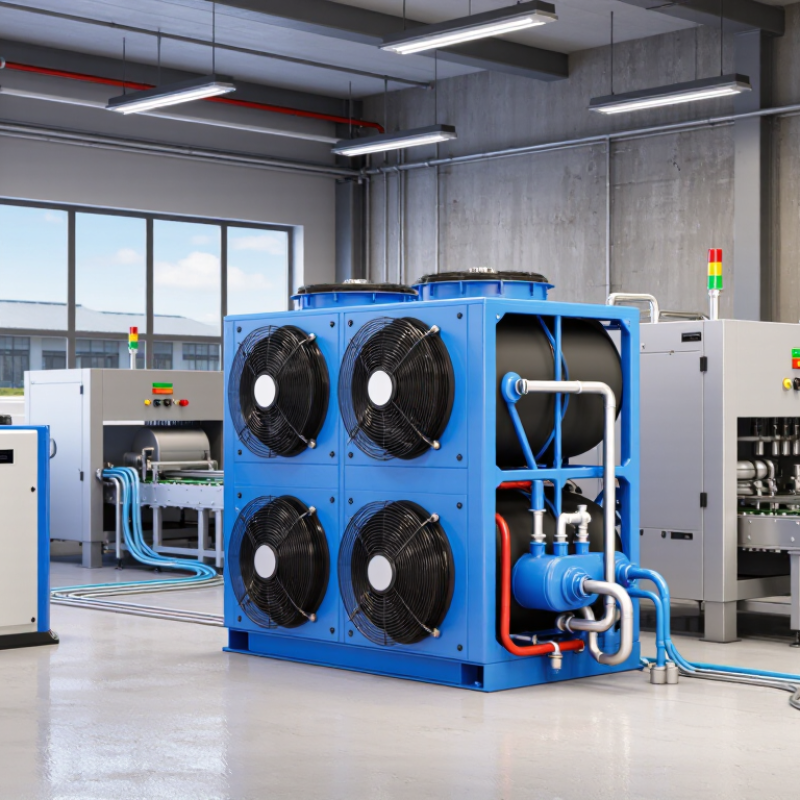
| Air-Cooled Scroll Chiller | Approximately 20–500 kW cooling capacity | R-410A, R-32, R-454B, or lower-GWP alternatives selected for the equipment design | Depends on refrigerant: A1 for non-flammable options; A2L for mildly flammable options | Sites with limited water supply, moderate maintenance requirements, and adequate outdoor airflow | Copper tubes with aluminium fins for normal atmospheres; coated or epoxy-protected coils for coastal or corrosive air | Simple installation, no cooling tower, lower water consumption, and suitable for many commercial facilities | Performance decreases at high outdoor temperatures; fan noise and coil fouling must be considered | Electrical safety, pressure-vessel protection, refrigerant charge limits, ventilation, service access, and applicable local A2L requirements |
| Water-Cooled Scroll Chiller | Approximately 100–1,000 kW cooling capacity | R-410A, R-513A, R-134a in legacy designs, or other refrigerants approved for the selected compressor and heat exchanger | Typically A1 for common non-flammable refrigerants; verify the exact refrigerant designation | Facilities with reliable condenser-water supply, cooling towers, and trained water-treatment personnel | Copper or stainless-steel tubes; stainless steel is preferred where water chemistry or chloride exposure is aggressive | More stable high-load performance and generally better heat rejection than air-cooled systems in hot climates | Requires cooling towers, pumps, water treatment, drainage, and regular condenser cleaning | Condenser-water treatment, Legionella risk management where applicable, pressure protection, electrical compliance, and local building regulations |
| Air-Cooled Screw Chiller | Approximately 300–1,500 kW cooling capacity | R-134a or lower-GWP replacements such as R-513A, subject to compressor and system approval | Commonly A1; confirm the safety classification on the nameplate and documentation | Large factories, logistics buildings, process cooling, and projects requiring robust part-load operation | Copper/aluminium air coils; stainless steel or protected metalwork for humid, salty, or chemically contaminated environments | High capacity, good turndown potential, and fewer water-side components than a water-cooled plant | Large footprint, higher outdoor-air heat rejection demand, and possible acoustic impact | Machinery guarding, pressure relief, electrical protection, structural loading, noise limits, and service clearances |
| Water-Cooled Screw Chiller | Approximately 500–3,000 kW cooling capacity | R-134a, R-513A, or other refrigerants specifically qualified for the screw compressor system | Often A1, but the final classification is refrigerant-specific | Central utility plants with high annual operating hours and sufficient mechanical-room infrastructure | Evaporator and condenser tubes selected according to water quality; stainless steel or enhanced alloys may be required for corrosive water | High capacity, efficient heat rejection, and effective operation for large continuous loads | Higher installation complexity and dependence on pumps, cooling towers, water treatment, and specialist service | Pressure equipment rules, mechanical-room ventilation, water-treatment procedures, electrical standards, and refrigerant handling regulations |
| Low-GWP A2L Refrigerant Chiller | Commonly available from small commercial systems to medium-capacity packaged units | R-32, R-454B, or R-1234ze(E), depending on the system design and applicable regulations | A2L: lower toxicity and mildly flammable | Projects prioritising lower global-warming impact and prepared to manage mildly flammable refrigerants | Materials must be compatible with the refrigerant, lubricant, pressure, and operating temperature; copper and approved elastomers are commonly used | Lower GWP than many legacy HFC options and better alignment with refrigerant-transition policies | Requires charge-limit assessment, suitable leak detection or airflow controls where required, ignition-source control, and trained technicians | Check ISO 5149, EN 378, IEC 60335-2-40, or the locally adopted equivalent; confirm installation, ventilation, signage, and service requirements |
| Process Water Chiller | Approximately 5–1,500 kW, depending on process temperature and load profile | Refrigerant chosen according to required leaving-water temperature, pressure range, efficiency, and local environmental rules | A1 or A2L options are possible; confirm the exact safety class before installation | Plastic processing, food production, laser equipment, electronics, laboratories, and other applications requiring stable water temperature | Stainless steel, copper, titanium, or corrosion-resistant plastics selected according to water chemistry and process-fluid compatibility | Precise temperature control, custom pumps and tanks, and compatibility with continuous industrial operation | Process contaminants, glycol concentration, low-temperature operation, and rapid load changes can reduce capacity or efficiency | Verify operating envelope, pump safety, freeze protection, pressure testing, emergency shutdown, electrical standards, and process risk assessments |
| High-Ambient Outdoor Chiller | Capacity must be selected at the project design ambient; commonly 20–1,500 kW | Refrigerant and compressor combination approved for the specified high-condensing-temperature range | A1 or A2L depending on the selected refrigerant | Hot climates, rooftop installations, dusty industrial zones, and locations with limited mechanical-room space | UV-resistant coatings, corrosion-protected coils, stainless fasteners, and weatherproof electrical enclosures | Maintains dependable operation where outdoor temperatures, solar exposure, dust, or humidity are significant | Higher condensing pressure can increase energy use; actual capacity may be substantially lower than nominal rating at standard conditions | Confirm capacity at design ambient, IP enclosure rating, wind and snow loads, lightning protection, noise limits, and refrigerant safety provisions |



 08045479132
 Send Inquiry

 Send Inquiry
 Send SMS