| High-Voltage Battery Power Connector | Battery modules, racks, DC combiner units, and power-conversion equipment | 400–1,500 V DC | 50–500 A | Touch-safe contacts, keyed mating, mechanical locking, high creepage and clearance, optional HVIL and pre-charge contacts | Protection against electric shock, accidental unmating under load, polarity reversal, arcing, and thermal overload | Connector design may be evaluated using IEC 61984 requirements. The complete battery system may be assessed under UL 1973. Where within scope, UL 4128 can support evaluation of DC connectors used in ESS applications. | High-voltage battery racks and modular storage cabinets |
| Busbar and Bolted Power Connection | High-current links between cells, modules, busbars, disconnects, and inverters | 48–1,500 V DC | 100–1,000+ A | Low-resistance conductive path, high short-circuit withstand capability, insulating covers, torque-controlled fasteners, and service disconnect provisions | Correct torque, contact pressure, insulation spacing, corrosion control, fault-current containment, and prevention of exposed live metal | IEC 61984 may apply when a separable connector assembly is used. UL 1973 evaluates the battery system and its interconnections as part of the overall construction. UL 4128 applicability depends on the connector construction and intended use. | Stationary systems requiring very high continuous current and low electrical loss |
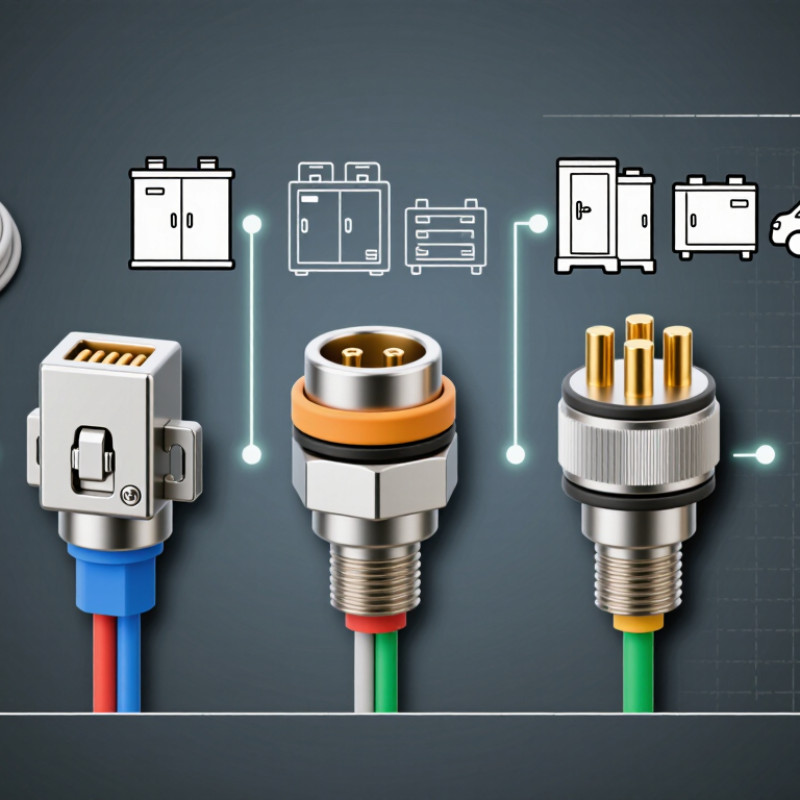
| Sealed Circular Power Connector | Outdoor battery cabinets, mobile storage units, auxiliary power paths, and exposed equipment interfaces | 24–800 V DC | 10–250 A | Circular keyed shell, sealing gaskets, threaded or bayonet coupling, strain relief, and optional shielding or auxiliary contacts | Water and dust ingress, vibration, cable pullout, incorrect mating, corrosion, and derating caused by elevated ambient temperature | IEC 61984 is relevant to connector safety and testing. IP performance is normally verified against the applicable enclosure or ingress-protection test requirements. UL 1973 remains a system-level battery standard rather than a connector-only rating. | Outdoor or vibration-prone ESS equipment requiring environmental sealing |
| Low-Voltage Control and BMS Connector | Battery-management systems, temperature sensors, contactor control, CAN communication, and interlock circuits | 5–60 V DC | 0.5–15 A | Polarized housings, positive terminal retention, vibration resistance, compact size, shielding options, and separate signal or power contacts | Signal integrity, pin-to-pin short prevention, EMC control, moisture resistance, and reliable low-level contact performance | IEC 61984 can be relevant to separable connector safety. The BMS and battery protection functions are evaluated within the applicable system and battery safety architecture, including UL 1973 where applicable. | Monitoring, control, communications, and safety-interlock wiring |
| Service Disconnect and Pre-Charge Connector | Maintenance isolation, safe rack removal, inverter connection, and capacitor pre-charge circuits | 400–1,500 V DC | 10–350 A continuous; higher fault ratings by design | Visible or mechanically indicated isolation, lockout provision, finger-safe construction, auxiliary contacts, pre-charge resistor path, and controlled sequencing | DC arc interruption, stored energy, lockout/tagout, accidental energization, pre-charge timing, and short-circuit coordination | UL 1973 may address the battery system's protective and disconnect architecture. IEC 61984 is relevant to connector construction where a separable connector is used. UL 4128 may be considered for qualifying applicable DC ESS connector assemblies. | Systems prioritizing service safety, controlled energization, and rapid maintenance isolation |



 08045479132
 Send Inquiry

 Send Inquiry
 Send SMS
