What is the Best Temperature Humidity Chamber for Your Needs?
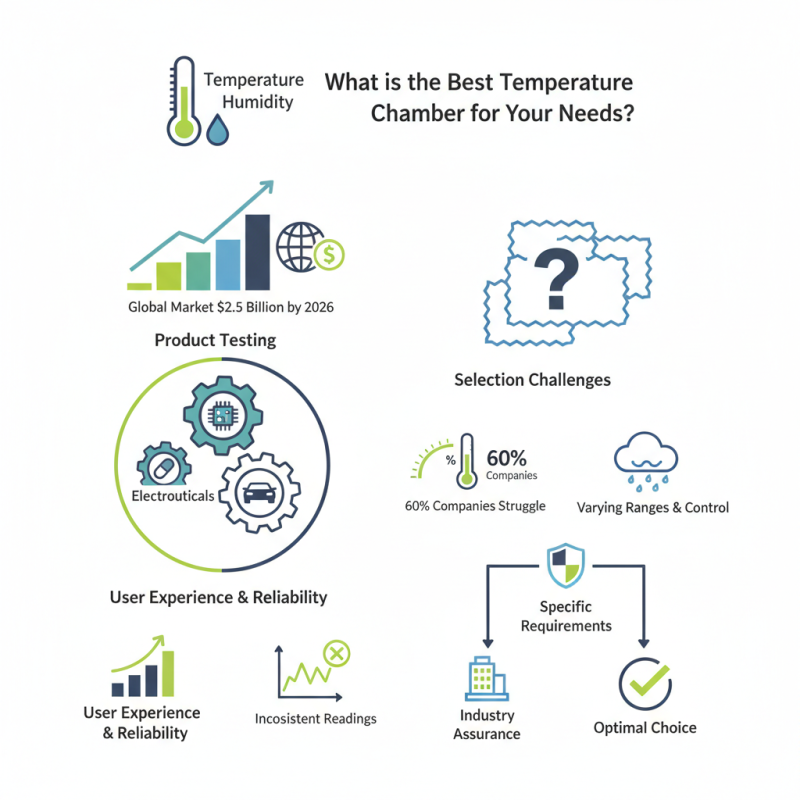
In the realm of environmental testing, selecting the right Temperature Humidity Chamber is crucial. Numerous industries rely on these chambers to simulate specific conditions for product testing. A recent report by MarketsandMarkets indicated that the global environmental chamber market is projected to reach $2.5 billion by 2026. This underscores the increasing demand for precise environmental testing methods.
Temperature Humidity Chambers are essential for evaluating how products respond to various climate conditions. Many manufacturers struggle to find the optimal chamber that meets their specifications and budgets. According to a study by ResearchAndMarkets, about 60% of companies found it challenging to select the right chamber due to varying temperature ranges and humidity control capabilities. These issues necessitate careful consideration in choosing the best equipment.
User experience plays a vital role in this selection process. Reliable data on performance and longevity can be hard to obtain. Many users report inconsistencies in humidity readings, which can lead to flawed testing outcomes. It’s vital to ensure that the Temperature Humidity Chamber you choose aligns with your specific testing requirements, while considering the nuances of your industry. This decision can greatly impact product development and quality assurance.
Understanding Temperature Humidity Chambers: An Overview
Temperature humidity chambers are crucial for various applications, including material testing and quality control. These chambers create controlled environments that simulate temperature and humidity conditions. This is essential for industries like pharmaceuticals, electronics, and food processing, where environmental factors can impact product stability and performance.
Choosing the right chamber involves understanding your specific needs. These units vary in size and capacity. Some are compact for small labs, while others are large for industrial use. Consider factors like temperature range, humidity control precision, and chamber construction materials. Proper insulation is vital to maintain stable conditions.
Many users overlook the maintenance aspect. Regular checks are necessary to ensure accuracy. Calibration is often needed to maintain reliability. Think about how often you’ll need access to the chamber and whether portability is essential. These considerations can save time and money in the long run.
Temperature and Humidity Levels for Various Applications
Key Features to Consider in Temperature Humidity Chambers
When selecting a temperature humidity chamber, key features play a crucial role. Firstly, you'll want to assess the range of temperature and humidity the chamber can maintain. Some applications require precise control, while others might work with broader ranges. Understanding these needs will guide your choice effectively.
It’s essential to look for user-friendly controls. Digital interfaces can simplify the monitoring process. A display that shows real-time data can help you make quick adjustments. Durability is also significant. Choose materials that withstand repeated use, especially if they will be subjected to harsh conditions.
Tip: Regular maintenance is crucial. Check seals and calibration frequently to ensure performance.
Another aspect to consider is the chamber’s capacity. If you conduct various experiments, a flexible space can be beneficial. Frames that allow for adjustable shelving optimize usability. Additionally, consider the energy efficiency of the unit. Power consumption can affect operational costs significantly.
Tip: Test your chamber regularly. This will help identify any inconsistencies in temperature or humidity control.
Types of Temperature Humidity Chambers and Their Applications
When selecting a temperature humidity chamber, understanding the types available is crucial. Each type serves specific applications and environments. For instance, environmental chambers simulate varying temperature and humidity conditions. They are often used in research and testing. Some chambers focus on temperature fluctuations alone, while others maintain stable humidity levels.
Another category includes stress test chambers. These are designed for accelerated life testing. They expose products to extreme conditions. This helps manufacturers identify potential failure points. Such chambers are integral in industries like electronics and automotive.
Specialized chambers exist for medical and pharmaceutical uses. These units maintain strict temperature and humidity controls. This ensures the integrity of sensitive materials. However, selecting the right chamber can be challenging. Users must evaluate their specific needs and the environment. It's essential to consider both performance and potential shortcomings. A choice made without thorough understanding may lead to inadequate results.
Factors Affecting the Selection of a Temperature Humidity Chamber
When selecting a temperature humidity chamber, several factors come into play. Understanding your specific testing requirements is crucial. Variables such as temperature range, humidity control, and chamber size can significantly impact your results. For example, a report from the International Society of Automation indicates that precise temperature control (+/- 0.5°C) is essential in ensuring accurate data for sensitive materials.
Humidity levels are equally important. The ideal humidity setting often ranges from 20% to 95% relative humidity, depending on your testing needs. According to a study by the National Institute of Standards and Technology, maintaining consistent humidity levels within +/- 2% is vital for reliability. Discrepancies can lead to uncontrolled variables that may skew results.
The size of the chamber is another critical consideration. A larger space might allow for more extensive experiments, but it could also lead to inefficiencies in maintaining consistent environmental conditions. If airflow is inadequate, this could cause uneven temperature distribution. Thus, evaluating your sample sizes against the chamber's specifications is essential. Careful planning can prevent both wasted resources and unreliable outcomes.
Maintenance Tips for Optimal Performance of Humidity Chambers
Humidity chambers are critical in various industries, from pharmaceuticals to food preservation. Proper maintenance ensures optimal performance and longevity. Frequent checks on humidity levels are essential. According to industry reports, a consistent humidity range of 30-70% is ideal for most applications. Deviations can lead to product degradation and reliability issues.
One common oversight is neglecting the water reservoir. It should be cleaned regularly to avoid mineral buildup. Use distilled water if possible. Regular calibration of sensors is also vital. Precision is crucial; even small deviations can compromise results. Aim to calibrate every six months, validating the humidity levels to industry standards.
Temperature fluctuations in the chamber can also affect outcomes. Ensure the chamber is placed in a stable environment, avoiding direct sunlight or excessive heat sources. Routine maintenance checks, along with adequate training for personnel, can mitigate many issues. It's important to document maintenance activities. Regular records help identify patterns or recurring problems, allowing for timely interventions.



 08045479132
 Send Inquiry

 Send Inquiry
 Send SMS