| Net-Weigh Filling | Weighs a measured quantity of product in a hopper, then discharges it into the bucket. | Commonly used for approximately 1–25 kg per bucket; actual range depends on the load cell and product. | Granules, pellets, seeds, dry food ingredients, powders with consistent flow, and industrial solids. | Good filling accuracy; target weight can be adjusted through the control system. | May require vibration control and a stable product flow to maintain accuracy. | High |
| Volumetric Filling | Dispenses a preset volume using a cup, chamber, or timed auger rotation rather than weighing every dose. | Best suited to products with relatively stable bulk density and flow behavior. | Uniform granules, powders, detergents, and some dry building materials. | Simple operation, fast dosing, and generally lower initial complexity. | Weight can vary when bulk density, particle size, or moisture changes. | Medium |
| Auger Filling | A screw auger meters powder or fine material into the bucket by controlling screw speed and rotation time. | Typically used for low- to medium-flow powders and fine particulate products. | Flour, powders, additives, mineral products, spices, and other dry materials. | Suitable for controlled powder dosing and enclosed material handling. | Dust control, product bridging, and screw wear may require additional attention. | High for powders |
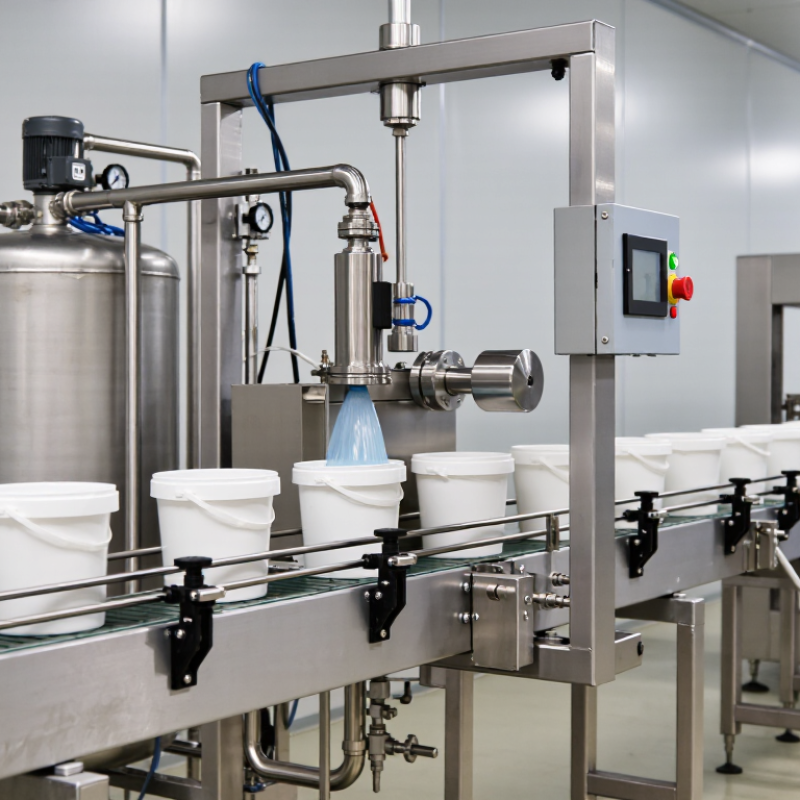
| Piston or Pump Filling | Uses a piston, pump, or servo-driven displacement system to transfer a measured amount of liquid or paste. | Selected according to viscosity, required fill volume, and product temperature. | Liquids, sauces, pastes, coatings, adhesives, and other pumpable products. | Provides controlled dosing for liquids and viscous products. | Product-contact components may need frequent cleaning and compatibility checks. | High for liquids |
| Bucket Size and Fill Range | Defines the container dimensions, bucket volume, opening size, and allowable fill weight. | Must match the smallest and largest buckets planned for production. | Plastic, metal, or rigid composite buckets with compatible shapes and openings. | Ensures reliable positioning, filling, and downstream handling. | Large variation in bucket dimensions may require change parts or adjustable tooling. | High |
| Required Throughput | Measures the number of filled buckets needed per minute or per hour, including indexing and changeover time. | Typical automatic systems may handle roughly 5–30 buckets per minute, depending on product and fill size. | Small-batch, medium-volume, and continuous production lines. | Helps prevent under-sizing and supports production planning. | Rated speed may decrease with large containers, difficult products, or frequent size changes. | High |
| Filling Accuracy | Indicates how closely each filled bucket meets the target weight or volume. | Often specified as a percentage, tolerance band, or standard deviation; the achievable result depends on the product and machine design. | Applications with material-cost control, legal metrology requirements, or strict batch specifications. | Reduces giveaway and supports consistent product quality. | Accuracy can be affected by density variation, dust, vibration, and inconsistent feeding. | High |
| Product Characteristics | Considers particle size, bulk density, flowability, moisture, temperature, abrasiveness, and viscosity. | Must be assessed using representative production material rather than product descriptions alone. | Free-flowing solids, cohesive powders, liquids, pastes, fragile products, and abrasive materials. | Improves dosing consistency and reduces blockages or product damage. | A machine suitable for one material may perform poorly with another material of the same nominal weight. | High |
| Automation Level | Ranges from manual bucket placement to automatic bucket feeding, filling, lidding, labeling, and discharge. | Manual, semi-automatic, or fully automatic configurations are available in the general market. | Low-volume operations through integrated high-volume packaging lines. | Determines labor requirements, consistency, and line integration potential. | Higher automation usually increases capital cost, controls complexity, and maintenance requirements. | High |
| Cleaning and Sanitation | Evaluates access to product-contact parts, tool-less removal, washdown design, and hygienic construction. | Requirements depend on the product, industry, allergen controls, and cleaning method. | Food, pharmaceutical, chemical, paint, and other applications requiring controlled cleaning. | Reduces downtime and helps prevent cross-contamination. | Washdown features may require sealed components and more specialized maintenance procedures. | High for hygienic products |
| Dust and Spill Control | Uses enclosed transfer points, extraction connections, covers, and controlled product discharge to limit emissions. | Required level depends on powder fineness, dust hazard, product toxicity, and workplace regulations. | Fine powders, minerals, chemicals, cementitious products, and dusty granules. | Improves worker safety, housekeeping, and equipment reliability. | May require external dust collection and additional engineering controls. | High for powders |
| Container Handling and Stability | Assesses bucket infeed, positioning, clamping, indexing, and discharge stability during filling. | Must accommodate bucket shape, center of gravity, stiffness, and line speed. | Rigid buckets with stable bases and consistent openings. | Reduces tipping, splashing, misalignment, and product loss. | Flexible, damaged, tapered, or irregular containers may require customized handling. | High |
| Controls and Data | Includes recipe storage, operator interface, alarms, batch records, and communication with upstream or downstream equipment. | Functionality should match traceability, reporting, and production-management needs. | Operations requiring repeatable recipes, multiple products, or production records. | Supports quick changeovers, troubleshooting, and process monitoring. | More advanced controls require compatible networking, training, and support. | Medium to High |
| Maintenance and Spare Parts | Considers access to wear parts, inspection points, lubrication needs, diagnostics, and spare-part availability. | Evaluate expected service intervals and the time required for routine maintenance. | All production environments, especially lines operating for extended shifts. | Reduces unplanned downtime and supports predictable operating costs. | Complex mechanisms may need trained technicians and scheduled servicing. | High |
| Utilities and Installation | Reviews electrical power, compressed air, floor space, exhaust requirements, and connection points. | Utility demand varies with actuator type, automation level, and dust-control equipment. | New lines, replacement projects, and facilities with limited infrastructure. | Prevents installation delays and helps estimate total operating cost. | Insufficient air pressure, power capacity, or space can limit machine performance. | Medium to High |



 08045479132
 Send Inquiry

 Send Inquiry
 Send SMS