| Chemical identity | Strontium nitrate; chemical formula Sr(NO3)2; CAS Registry Number 10042-76-9 | Product specification, label, SDS, and certificate of analysis (COA) | The chemical name, formula, and CAS number are consistent across all documents | Possibility of receiving a different strontium compound or an incorrectly classified material |
| Molecular-weight reference | Relative molecular mass is approximately 211.63 g/mol for anhydrous Sr(NO3)2 | Technical data sheet or analytical specification | The stated molecular mass matches the anhydrous chemical formula and is not confused with a hydrate | Incorrect stoichiometric calculations, concentration errors, or unsuitable process dosing |
| Purity grade | Purity must be selected according to the intended use; laboratory, industrial, and electronic applications may require different limits | Product specification and lot-specific COA showing the tested assay result | The quoted purity limit is equal to or higher than the buyer's written process requirement | Uncontrolled impurities may affect yield, color, conductivity, or downstream reactions |
| Impurity profile | Relevant limits may include chloride, sulfate, iron, calcium, heavy metals, insoluble matter, and moisture, depending on application | COA with numerical results, test methods, units, and specification limits | Every critical impurity has a defined limit and a reported result for the supplied lot | A high-purity claim cannot be independently assessed or compared between quotations |
| Particle form and appearance | The material may be supplied as crystals or powder; particle size and appearance should be defined for the process | Technical data sheet, sieve analysis, microscopy result, or agreed visual standard | Particle-size range, color, flowability, and caking limits are agreed before purchase | Poor dissolution, dust generation, inconsistent feeding, or batch-to-batch processing changes |
| Oxidizing-property controls | Strontium nitrate is an oxidizing nitrate salt and must be evaluated under the current applicable hazard-classification and transport rules | Current SDS, transport classification, packaging instruction, and emergency information | The classification is current, jurisdiction-specific, and consistent with the shipping documents | Rejected shipments, unsafe storage, fire escalation, or regulatory non-compliance |
| Safety Data Sheet | The SDS should identify hazards, first aid, firefighting, accidental release, handling, storage, exposure controls, disposal, and transport information | Current SDS in the language required at the receiving site | All applicable sections are completed and the revision date is current before shipment | Warehouse personnel may lack accurate handling and emergency instructions |
| Certificate of analysis | A lot-specific COA should identify the batch, test date, test methods, specification limits, and actual results | Signed or electronically controlled COA linked to the shipping lot | The batch number on the COA exactly matches the container label and purchase documents | The received material cannot be traced or objectively released by quality control |
| Testing methodology | Analytical methods should be identified for assay, moisture, particle size, and each critical impurity | Method references, laboratory scope, and representative test data | Methods are suitable for the parameter being measured and are applied consistently between lots | Results may not be reproducible or comparable across suppliers |
| Manufacturing quality system | A documented quality system should control raw materials, production, laboratory testing, nonconformities, and change management | Quality-system certificate, audit summary, or completed supplier questionnaire | Certification scope covers the relevant manufacturing or testing activity and remains valid | Inconsistent quality and limited ability to investigate deviations |
| Traceability | Each container should be linked to a production lot, manufacturing date, and quality release record | Container label, batch record reference, and recall procedure | Two-way traceability exists from shipment to lot and from lot to test and release records | Affected material cannot be isolated efficiently during a complaint or recall |
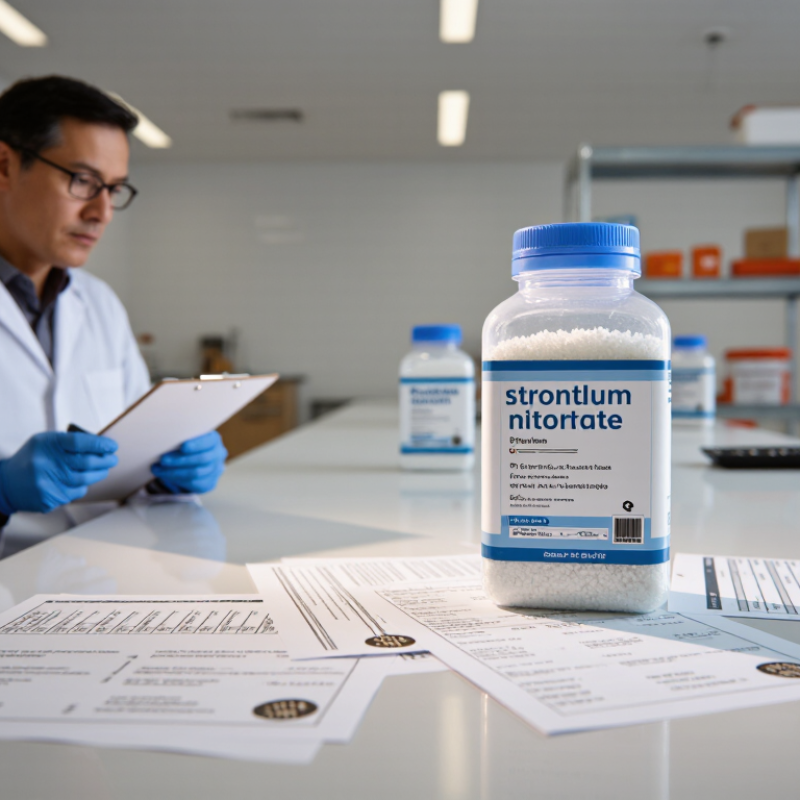
| Packaging and labeling | Packaging must protect the oxidizing salt from contamination, moisture, physical damage, and incompatible materials | Packaging specification, photographs, label sample, and palletizing details | Containers are sealed, undamaged, clearly labeled, and suitable for the declared transport conditions | Contamination, caking, leakage, incorrect identification, or transport rejection |
| Storage requirements | Store in a cool, dry, well-ventilated area away from combustible materials, reducing agents, acids, and contamination sources | SDS storage section and supplier handling guidance | The receiving site confirms compatible segregation, housekeeping, and moisture control | Higher fire, contamination, caking, and worker-exposure risk |
| Shelf life and retest date | Shelf-life or retest policy should be defined because storage conditions can affect moisture, caking, and suitability | Manufacturing date, retest date, storage conditions, and requalification procedure | The remaining usable period meets the buyer's minimum requirement at delivery | Shortened usable life or unexpected quality failures during storage |
| Regulatory and import readiness | The buyer and supplier must confirm applicable chemical registration, workplace, customs, and transport requirements for the destination country | Regulatory statement, customs data, SDS, invoice description, and transport documents | All documents use consistent identity, classification, quantity, and packaging information | Customs delays, returned cargo, fines, or inability to legally receive the material |
| Pre-shipment sample and approval | A representative sample can be evaluated before committing to the full order when process sensitivity is high | Sample label, sample COA, retention sample policy, and internal test results | The sample passes the buyer's identity, purity, impurity, moisture, and physical-form checks | A full shipment may fail after delivery, creating disposal and replacement costs |
| Complaint and corrective-action process | The supplier should have a defined process for investigating nonconforming material and implementing corrective action | Written complaint procedure, response-time commitment, and sample corrective-action record | Nonconformities are documented, investigated, and resolved with traceable actions | Repeated failures, unclear responsibility, and prolonged production interruption |



 08045479132
 Send Inquiry

 Send Inquiry
 Send SMS