| Machine Definition | Primary Function | Continuous cold roll forming | A roof sheet roll forming machine progressively bends a continuous metal strip through a series of shaped rollers to produce roofing profiles with a consistent cross-section. |
| Machine Definition | Finished Product | Trapezoidal, corrugated, tile-effect, or concealed-fix roof panels | The machine is intended for architectural roofing, wall cladding, industrial buildings, warehouses, workshops, agricultural structures, and commercial construction. |
| Input Material | Common Coil Materials | Pre-painted steel, galvanized steel, galvalume steel, and aluminum | Material selection depends on corrosion resistance, structural requirements, appearance, local climate, and compatibility with the selected roll-forming profile. |
| Input Material | Material Thickness | Approximately 0.30–0.80 mm for common roofing applications | The usable thickness range is determined by the profile geometry, material yield strength, roller design, drive capacity, and customer specifications. |
| Input Material | Coil Width | Approximately 900–1,250 mm, depending on the profile | The required coil width is normally greater than the finished cover width because part of the strip is consumed by bends, overlaps, and profile geometry. |
| Product Dimensions | Effective Cover Width | Approximately 750–1,100 mm | Effective cover width is the installed roofing width after side-lap or interlocking features are excluded. It is different from the total formed width. |
| Product Dimensions | Profile Height | Approximately 20–75 mm for many metal roof profiles | Profile height affects drainage performance, visual appearance, structural stiffness, lap design, and the amount of steel required for a specific span. |
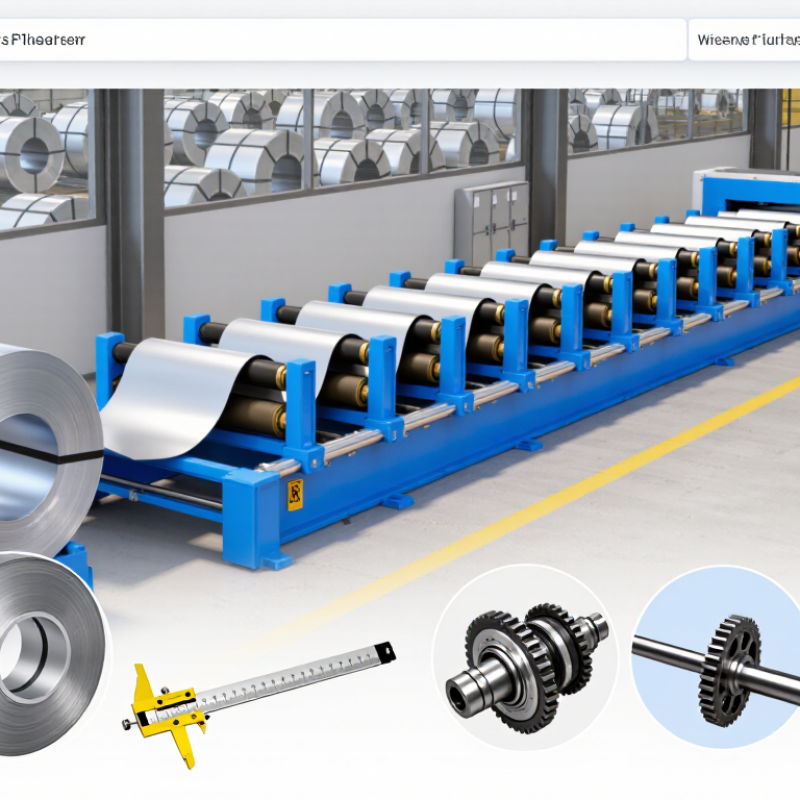
| Forming System | Roller Stations | Approximately 8–24 forming stations | The number of stations varies with profile complexity, material thickness, bend radius, required surface quality, and the available machine layout. |
| Forming System | Roller Material | Machined steel rollers; hardened or treated surfaces may be used | Rollers must resist wear and maintain dimensional accuracy. Surface treatment can help reduce scratches and extend service life when correctly specified. |
| Production Performance | Typical Forming Speed | Approximately 8–30 m/min, excluding setup and cutting time | Actual output depends on profile complexity, material thickness, line configuration, cutting method, coil changes, operator settings, and quality-control requirements. |
| Production Performance | Length Tolerance | Commonly controlled to about ±1–2 mm per cut piece | The achievable tolerance depends on encoder accuracy, hydraulic or servo cutting control, material stability, machine calibration, and the specified production length. |
| Drive and Control | Drive Arrangement | Electric motor with gearbox and chain, gear, or cardan transmission | The drive system transfers torque to the forming stations. The appropriate arrangement depends on line speed, strip thickness, profile resistance, and maintenance preferences. |
| Drive and Control | Control System | PLC, touchscreen interface, encoder, and variable-frequency drive | The control system coordinates line start and stop, forming speed, automatic length measurement, batch quantity, fault alerts, and cutting operations. |
| Cutting System | Cutting Method | Hydraulic stop-to-cut or flying-cut configuration | Stop-to-cut systems pause the strip before cutting, while flying-cut systems can cut during movement and may support higher continuous production efficiency. |
| Line Components | Standard Equipment | Decoiler, leveling or guiding section, roll former, cutting unit, and run-out table | These components support coil unwinding, strip alignment, progressive forming, finished-length cutting, and safe collection of completed roof panels. |
| Decoiler | Typical Coil Capacity | Approximately 3–10 tonnes for common production lines | The required capacity depends on coil availability, material weight, loading equipment, production volume, and whether the decoiler is manual, hydraulic, or motorized. |
| Electrical Requirements | Common Power Supply | Three-phase 380–415 V, 50 Hz; other regional configurations are possible | Electrical specifications must be matched to the installation location. Actual total power depends on the motor, hydraulic station, control system, and auxiliary equipment. |
| Finished Products | Maximum Panel Length | Often limited by transport, handling, installation, and site logistics rather than forming capability | Long panels can reduce roof lap joints, but panel length should be selected according to coil length, building layout, transportation limits, lifting equipment, and thermal movement considerations. |
| Quality and Safety | Key Inspection Points | Profile width, height, straightness, cut length, surface finish, and interlocking accuracy | Routine inspection helps verify that formed sheets meet design drawings and can be installed without excessive gaps, distortion, coating damage, or dimensional mismatch. |
| Application Scope | Typical Building Uses | Factories, warehouses, workshops, agricultural buildings, retail facilities, and residential projects | Roof sheet roll forming machines are suitable for manufacturers and fabricators that need repeatable production of metal roofing panels in standard or customized profiles. |
| Customization Scope | Configurable Features | Profile geometry, cover width, thickness range, cutting length, automation level, and decoiler capacity | Customization should be based on approved profile drawings, material specifications, regional building practices, expected output, available floor space, and maintenance capability. |



 08045479132
 Send Inquiry

 Send Inquiry
 Send SMS
