China Best Heat Proof Flexible Air Duct Manufacturer?
Choosing the China Best Heat-Proof Flexible Air Duct Manufacturer requires more than comparing prices or catalog photographs.
A reliable supplier should demonstrate tested temperature resistance, stable airflow, strong reinforcement, and careful seam construction. In practical HVAC work, small defects matter. A loose clamp can leak. Thin insulation can collapse near hot equipment. A poorly bonded inner wall may crack after repeated heating and cooling.
HVAC engineer and ASHRAE member David Sellers, P.E., expresses the core principle clearly: “A duct system only performs as well as its installation allows.” This statement deserves attention when evaluating any Heat-Proof Flexible Air Duct manufacturer.
China has many capable producers, but their quality can differ considerably. Experienced manufacturers should provide material specifications, temperature ratings, pressure data, production photos, and inspection records. They should also explain whether the duct uses silicone-coated fiberglass, aluminum foil, stainless steel wire, or other reinforcement.
Factory experience matters. A supplier that understands furnaces, ovens, boilers, exhaust systems, and industrial ventilation can identify practical risks before shipment. Ask how the product behaves during bending, vibration, abrasion, and continuous high-temperature operation.
No single duct fits every application. That conclusion is not perfect, but it is honest. A duct designed for short-term heat exposure may fail under constant thermal cycling. A strong-looking outer layer may hide a weak liner.
This guide examines how to compare Chinese manufacturers through evidence, engineering support, customization ability, and after-sales reliability. The best choice is not always the cheapest. It is the supplier that can prove performance under real operating conditions.
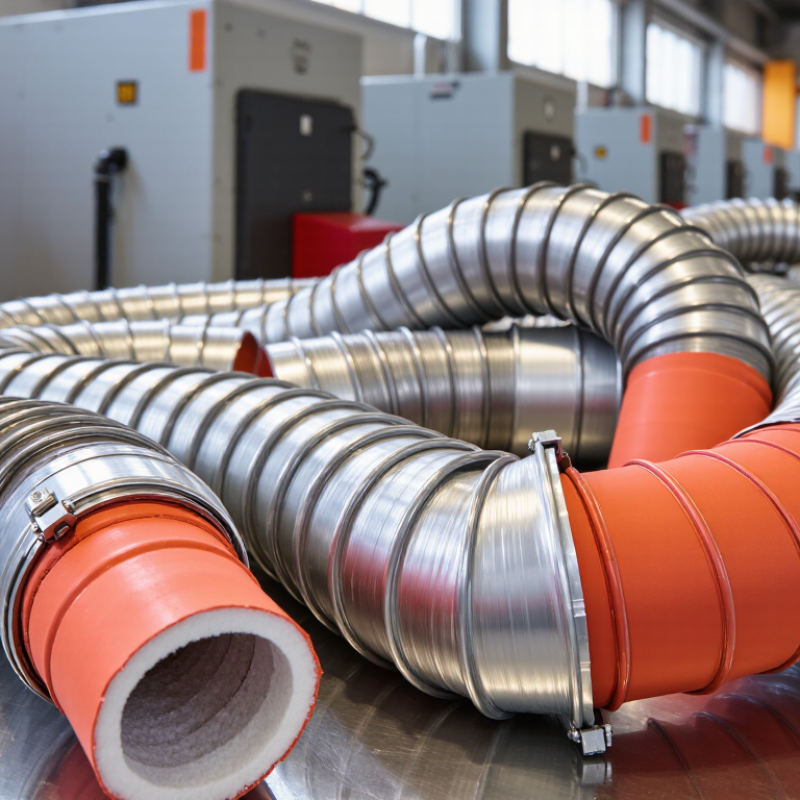
Heat-Resistant Flexible Air Duct Types and Temperature Ratings: 150–260°C
China Best Heat Proof Flexible Air Duct Manufacturer?
Heat-resistant flexible air ducts are commonly rated from 150°C to 260°C. The right choice depends on heat exposure, airflow, pressure, and installation distance. Silicone-coated fiberglass ducts often handle around 150–260°C. They remain flexible around furnaces, ovens, and engine compartments. Ceramic fiber ducts tolerate intense heat, but they can be more fragile during repeated bending. Stainless steel flexible ducts provide stronger mechanical protection. However, they may transfer heat quickly to nearby components.
A 260°C rating does not mean continuous service under every condition. Some products reach this temperature only for short periods. Check the continuous working temperature, peak temperature, pressure rating, and test method. I have found that rushed installations often damage the outer coating at sharp bends. Keep the recommended bend radius. Use suitable clamps, and avoid direct contact with glowing surfaces. Thermal cycling also matters. A duct that performs well during one test may weaken after months of expansion and contraction.
Tips:
Confirm the temperature at the duct wall, not only the air temperature. Inspect seams after the first week of operation. Select a manufacturer that provides clear test reports, material details, and practical installation guidance. If the application is near 260°C, request a sample test under real airflow conditions. Ratings can be misunderstood. Recheck them.



 08045479132
 Send Inquiry

 Send Inquiry
 Send SMS