| 1 | Primary Product Standard | ASTM B265 and ASME SB265 cover titanium and titanium alloy sheet, strip, and plate requirements. | Confirms that chemical composition, mechanical properties, dimensions, testing, and inspection can be supplied against recognized specifications. |
| 2 | Commercially Pure Titanium Grades | Grades 1, 2, 3, and 4 are commercially pure titanium grades with increasing strength as the grade number rises. | Useful for heat exchangers, chemical processing, seawater equipment, and applications where corrosion resistance and formability are priorities. |
| 3 | Common High-Strength Alloy | Grade 5, Ti-6Al-4V, typically contains approximately 5.5–6.75% aluminum and 3.5–4.5% vanadium by mass. | A major aerospace, marine, medical, and energy-grade alloy requiring controlled melting, rolling, heat treatment, and testing. |
| 4 | Enhanced Corrosion-Resistance Grades | Grade 7 is commercially pure titanium with a small palladium addition; Grade 12 contains molybdenum and nickel additions. | These grades are considered for severe chemical, chloride, and reducing-acid environments where standard grades may be insufficient. |
| 5 | Aerospace and Medical Variant | Grade 23, Ti-6Al-4V ELI, is a lower-interstitial version of Grade 5 designed for improved fracture toughness and ductility. | Important for aerospace structures, surgical components, implants, and other applications requiring tighter material control. |
| 6 | Typical Material Density | Commercially pure titanium is approximately 4.51 g/cm³; Ti-6Al-4V is approximately 4.43 g/cm³. | Lower density than many steels supports weight reduction while retaining high specific strength. |
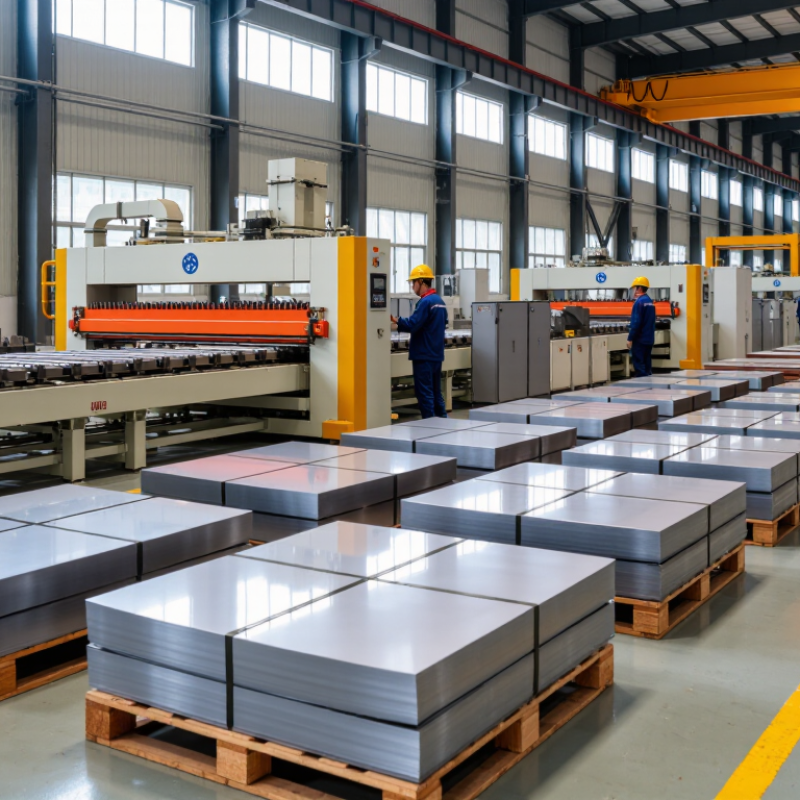
| 7 | Sheet Manufacturing Processes | Typical processes include vacuum melting, hot rolling, cold rolling, annealing, pickling, surface conditioning, leveling, and cutting. | A complete process chain helps control thickness tolerance, flatness, surface quality, residual stress, and repeatability. |
| 8 | Surface-Finish Options | Common finishes include pickled, blasted, polished, bright-annealed, and mechanically conditioned surfaces. | Surface selection affects corrosion performance, appearance, weld preparation, cleanliness, and downstream fabrication cost. |
| 9 | Quality-Control Documentation | A complete material test report should normally identify heat number, grade, chemistry, tensile properties, dimensions, surface condition, and inspection results. | Traceability documents allow buyers to verify conformity and link each sheet or lot to its production and testing records. |
| 10 | Inspection and Testing Capability | Relevant checks may include chemical analysis, tensile testing, hardness testing, dimensional inspection, ultrasonic testing, and visual examination. | Verified testing capability reduces the risk of nonconforming material in aerospace, medical, chemical-processing, and marine projects. |



 08045479132
 Send Inquiry

 Send Inquiry
 Send SMS