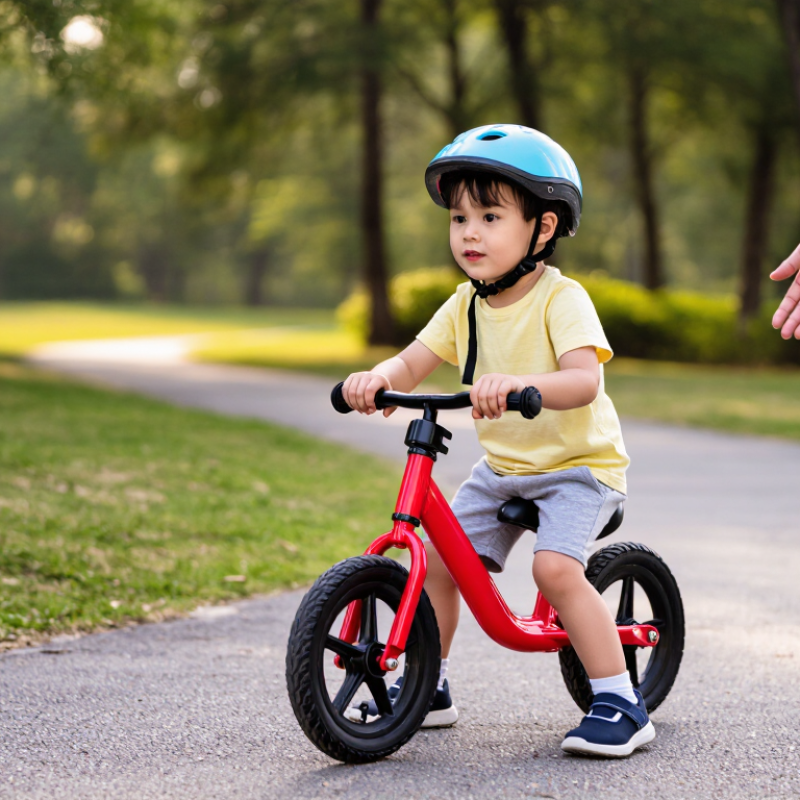
| Low, adjustable saddle | The saddle should adjust to the child’s inseam. Many balance-bike guides suggest setting it so the child can sit with both feet flat on the ground and knees slightly bent. | Ground contact lets a learner push off, slow down, and steady the bike with their feet. | Check the manufacturer’s saddle-height range and make sure the child can reach the ground comfortably while seated. |
| Child-appropriate frame size | Frame fit varies by model. Common balance-bike wheel sizes include 10, 12, and 14 inches; wheel size alone does not determine fit. | A manageable frame helps the child steer and place both feet down without stretching. | Use the maker’s height or inseam guidance, and assess the actual saddle-height range rather than choosing by age alone. |
| Lightweight construction | Bike weight differs by frame material, wheel type, and components. There is no single weight that suits every child. | A bike the child can control and lift more easily may be less tiring to start, stop, and maneuver. | Compare the bike’s listed weight with the child’s ability to handle it safely; consider the complete bike, not frame material alone. |
| Stable wheelbase and geometry | Frame geometry and wheelbase differ among models. A well-fitted bike should allow a comfortable upright or slightly forward riding position. | Predictable handling helps children practice steering while gradually lifting their feet to glide. | Look for a bike that tracks steadily at walking speed and does not feel awkwardly long or cramped for the rider. |
| Appropriate tire type | Balance bikes may use pneumatic (air-filled), foam, or solid tires, depending on the model. | Tires suited to the riding surface can provide more predictable rolling and handling; air-filled tires also absorb some surface vibration. | Match the tire to typical surfaces and check whether air-filled tires need regular pressure checks. |
| Easy-to-reach handlebars | Handlebar height and reach should suit the child’s seated position; some models offer height adjustment. | A relaxed reach makes it easier to steer smoothly without overextending or leaning excessively. | Check that the child can hold the grips comfortably, turn the bars freely, and maintain a controlled posture. |
| Steering limiter and grip ends | Some bikes include a steering limiter; handlebar grips may have enlarged ends. These features are not universal. | A limiter can restrict abrupt handlebar rotation, while covered grip ends help protect hands during ordinary use. | If present, check that the limiter still allows useful steering and that grips are secure and undamaged. |
| Optional hand brake | Some balance bikes have a hand brake; others rely on the rider’s feet for stopping. Brake equipment varies by model. | A correctly adjusted brake can help a child practice hand braking as speed and confidence increase. | Choose a lever the child can reach and squeeze, and teach braking in a safe, open area. A brake does not replace supervision. |



 08045479132
 Send Inquiry

 Send Inquiry
 Send SMS