How to Choose a Solar Power System for RV?
Choosing a Solar Power System For Rv begins with your real camping habits, not an impressive panel number.
Will Prowse, a respected solar educator, offers a practical warning: “Solar panels are cheap; batteries are expensive.” His point matters when every compartment has limited space. List your daily loads first. Include a compressor refrigerator, LED lights, a water pump, fans, laptops, and phone chargers. A 12-volt refrigerator may use less energy than a coffee maker, but it runs repeatedly. Small details become large totals.
Then compare battery capacity, solar wattage, charge-controller type, and inverter needs. Lithium batteries usually provide more usable energy and less weight. However, they cost more and need suitable charging protection. A 200-watt array may support light weekend use. It may struggle during cloudy weather or winter travel. Measure your roof carefully. Air conditioners, vents, and roof shadows can reduce usable panel space.
Do not ignore installation quality. Use correctly sized cables, secure mounting, proper fuses, and a battery monitor. A professional inspection can prevent overheating, loose connections, or disappointing performance. Specifications are useful, but real conditions are messier. Shade from one tree can change the result. Parking direction matters too.
There is no perfect setup. A careful owner records energy use for several trips, then adjusts the system. That reflection often reveals an uncomfortable truth: the biggest appliance may not be the biggest problem. Reliable power comes from balanced design, realistic expectations, and safe installation.
Assess Your RV’s Energy Needs and Travel Habits
Choosing a Solar Power System for RVs
Your energy needs depend on more than the number of appliances onboard. Track each device, its wattage, and daily running time for several days. Include lighting, refrigeration, water pumps, ventilation, laptops, and medical equipment. Multiply watts by hours to estimate daily watt-hours. Add a practical reserve of 20 to 30 percent for cloudy weather and conversion losses. A short power audit is more useful than guessing from another traveler’s setup.
Your travel habits matter just as much. Weekend trips with powered campsites require less solar capacity than long stays in remote areas. Frequent driving may recharge batteries through the vehicle, while shaded forest camps can reduce solar production sharply. I once planned around clear summer skies and underestimated winter heating demand. That mistake taught me to compare seasonal sunlight, parking orientation, and expected campsite access. Check the battery’s usable capacity, not only its advertised capacity. Electrical sizing should follow the equipment manuals and, when uncertain, advice from a qualified technician.
Tips: Record real usage before buying anything. Test your highest-demand appliance separately. Keep a simple daily log. Leave room for poor weather. If your energy estimate feels optimistic, it probably is.
How to Choose a Solar Power System for an RV
Assess Your RV’s Energy Needs and Travel Habits
This typical travel-day estimate uses approximately 1,170 Wh per day. A system of about 300–400 W of solar capacity may be suitable in locations with around four peak sun hours, assuming approximately 80% overall system efficiency. Frequent cooking, air-conditioning, heating, or longer off-grid stays will require more capacity.
Select Batteries and a Charge Controller for Energy Storage
Choosing a Solar Power System for an RV: Select Batteries and a Charge Controller for Energy Storage
Battery selection should begin with your daily energy use, not the panel’s advertised wattage. List lights, a refrigerator, water pump, fans, and inverter loads. Record each device’s watts and hours of operation. Small mistakes matter. A 12-volt, 100-watt appliance running for three hours uses about 25 amp-hours. Leave extra capacity for cloudy weather and battery aging. Deep-cycle lithium batteries usually provide more usable energy and less weight, while lead-acid batteries can cost less initially. However, lead-acid batteries often need greater ventilation and should not be deeply discharged repeatedly.
Choose a charge controller that matches the battery voltage and solar array voltage. MPPT controllers generally harvest more energy, especially when panel voltage exceeds battery voltage or sunlight is weak. PWM controllers may suit small, simple systems with closely matched panels. Check the controller’s maximum solar voltage, charging current, and battery charging profile. A controller rated too closely to the array can become a weak point. Add properly sized fuses near the battery, use suitable cable thickness, and protect connections from vibration and moisture.
Real RV use rarely matches the spreadsheet. A cloudy campsite, shaded panel, or forgotten inverter can change everything. I would test the system for several trips and compare actual battery readings with estimated consumption. That process may reveal an undersized battery or an oversized controller. Keep the setup expandable, but avoid buying capacity that your panels cannot recharge reliably.
How to Choose a Solar Power System for RV? - Select Batteries and a Charge Controller for Energy Storage
| RV Energy-Storage Option | Nominal Voltage | Typical Capacity | Recommended Usable Energy | Approximate Weight | Recommended Charge Controller | Suitable Solar Array Range | Best Use Case |
| Lead-acid battery | 12 V | 100 Ah | About 600 Wh | Approximately 25–32 kg | MPPT controller, 20–30 A; PWM can be used for small, cost-sensitive systems | Up to approximately 300 W, depending on battery specifications and charging conditions | Occasional trips with basic loads such as LED lighting, phone charging, and a small water pump |
| Absorbent glass mat battery | 12 V | 100 Ah | About 600 Wh | Approximately 27–32 kg | MPPT controller with a battery profile suitable for AGM batteries; typical current rating is 20–30 A | Approximately 200–300 W | RVs requiring a sealed, low-maintenance battery for moderate off-grid use |
| Lithium iron phosphate battery | 12.8 V | 100 Ah | About 1,024 Wh | Approximately 10–14 kg | MPPT controller with a lithium charging profile; typical current rating is 30–40 A | Approximately 300–500 W | Frequent off-grid travel, higher daily energy use, and situations where low weight and deeper discharge are important |
| Two 12 V batteries in series | 24 V | 100 Ah at 24 V | About 1,200 Wh with lead-acid or about 2,048 Wh with lithium at stated usable limits | Depends on battery chemistry and configuration | 24 V MPPT controller; approximately 20–30 A for a 500–700 W array | Approximately 500–700 W | Large RV electrical systems with longer cable runs and several high-power appliances |
| Four 12 V batteries in a 2S2P configuration | 24 V | 200 Ah at 24 V | About 2,400 Wh with lead-acid or about 4,096 Wh with lithium at stated usable limits | Depends on battery chemistry and configuration | 24 V MPPT controller; approximately 40–60 A for a 1,000–1,400 W array | Approximately 1,000–1,400 W | Full-time RV living or high daily consumption from inverters, refrigeration, communication equipment, and office loads |
Selection guide: For lead-acid batteries, planning around 50% depth of discharge helps protect service life. Lithium iron phosphate batteries commonly provide about 80–90% usable capacity when permitted by the battery-management system. A practical estimate for controller current is solar-array wattage divided by battery-bank voltage, with additional allowance for operating conditions. Always follow the battery manufacturer’s charging-voltage, temperature, fuse, and maximum-current requirements.
Plan System Installation, Maintenance, and Future Expansion
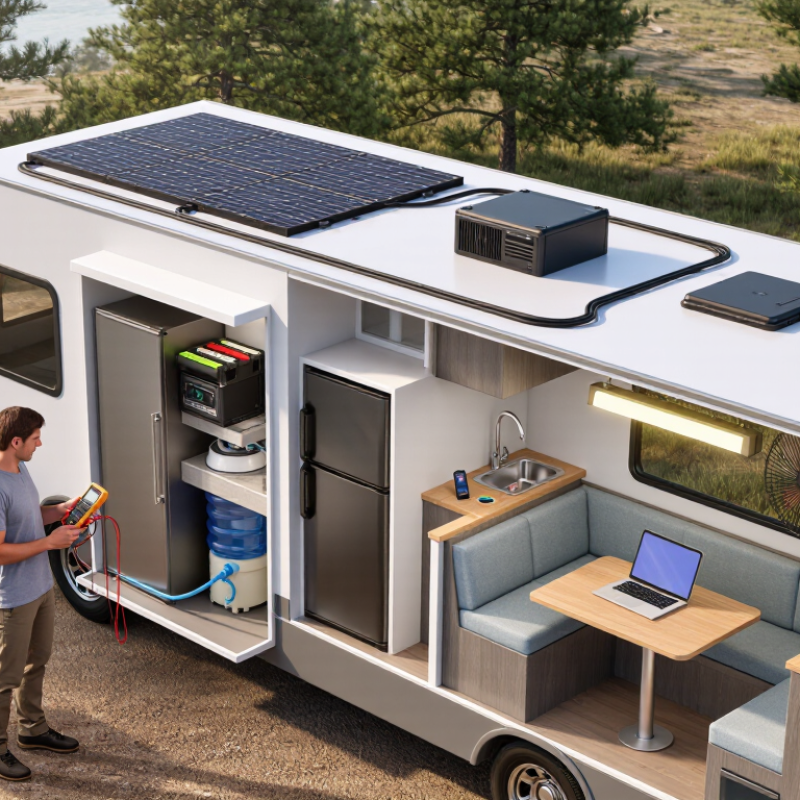
Choosing a solar power system for an RV starts with installation planning, not panel wattage. List daily loads, including a refrigerator, lights, fans, device chargers, and an inverter. Measure real usage with a plug-in meter for several trips. My early estimates were too optimistic. Shade from a roof vent can reduce output sharply.
Use NREL’s PVWatts Calculator for location-based production estimates. Its standard model assumes 14% system losses, but an RV may lose more through tilted parking, dust, heat, wiring, and controller limits. Leave roof space for safe access and future panels. Keep cables short, protect them from abrasion, and provide ventilation around batteries. A licensed professional should verify electrical protection and installation requirements.
Maintenance should be simple and scheduled. Inspect cable glands after rough roads, clean panels when visibly dirty, and check battery terminals every few months. Record battery voltage, solar harvest, and unusual inverter behavior. NREL research commonly reports photovoltaic degradation near 0.5% annually, so a properly planned system should retain useful output for years. Still, batteries usually need earlier replacement. Plan spare controller capacity and conduit routes now. The International Energy Agency Photovoltaic Power Systems Programme also emphasizes performance monitoring as a key part of reliable operation. Expansion can fail when the original battery chemistry, voltage, or charge settings cannot match new equipment. That detail is easy to overlook.



 08045479132
 Send Inquiry

 Send Inquiry
 Send SMS