| Definition | A steel pipe engineered or manufactured to meet project-specific requirements for dimensions, material, performance, end preparation, coating, or inspection. | Specifications may be adapted for outside diameter, wall thickness, length, grade, connection type, and surface protection. | Provides a closer fit to local regulations, design loads, installation methods, and service conditions than a standard off-the-shelf product. |
| Manufacturing Routes | Pipe can be produced by seamless, electric-resistance-welded, or longitudinal/submerged-arc-welded processes. | Seamless pipe is formed without a welded seam; welded pipe is formed from plate or strip and joined along a longitudinal or helical seam. | The production route can be selected according to diameter, wall thickness, pressure duty, availability, and project budget. |
| Size Flexibility | Outside diameter and wall thickness can be specified to match structural, hydraulic, or process requirements. | Common engineering specifications use nominal pipe size or outside diameter in millimetres, with wall thickness in millimetres. | Custom sizing can reduce unnecessary steel usage, simplify interfaces, and improve fit-up during installation. |
| Steel Grades | The steel grade is selected according to strength, toughness, weldability, temperature, and corrosion requirements. | Carbon-steel pipe grades commonly specify minimum yield strengths such as approximately 205 MPa, 245 MPa, or 345 MPa, depending on the applicable standard and grade. | Material selection can be aligned with regional design codes, low-temperature service, high-pressure operation, or structural loading. |
| Dimensional Control | Manufacturing tolerances are controlled for diameter, wall thickness, length, straightness, ovality, and end squareness. | The permitted tolerance depends on the governing product standard; wall-thickness tolerances are commonly specified as a percentage of nominal thickness. | Consistent dimensions improve welding, flange alignment, prefabrication, field assembly, and interchangeability. |
| Pressure and Structural Performance | Pipe performance is designed around internal pressure, external loads, bending, buckling, impact, and fatigue where applicable. | Pressure capacity depends on diameter, wall thickness, yield strength, weld quality, temperature, corrosion allowance, and design code. | Project-specific design helps balance safety, material consumption, transportation weight, and installation requirements. |
| Connection Options | Ends may be supplied plain, beveled, threaded, grooved, flanged, or prepared for a specified coupling or welding procedure. | Typical bevel angles for butt-welding preparation are about 30° to 37.5°, subject to the approved welding procedure and applicable standard. | Connection customization reduces on-site modification and supports different installation practices across regions. |
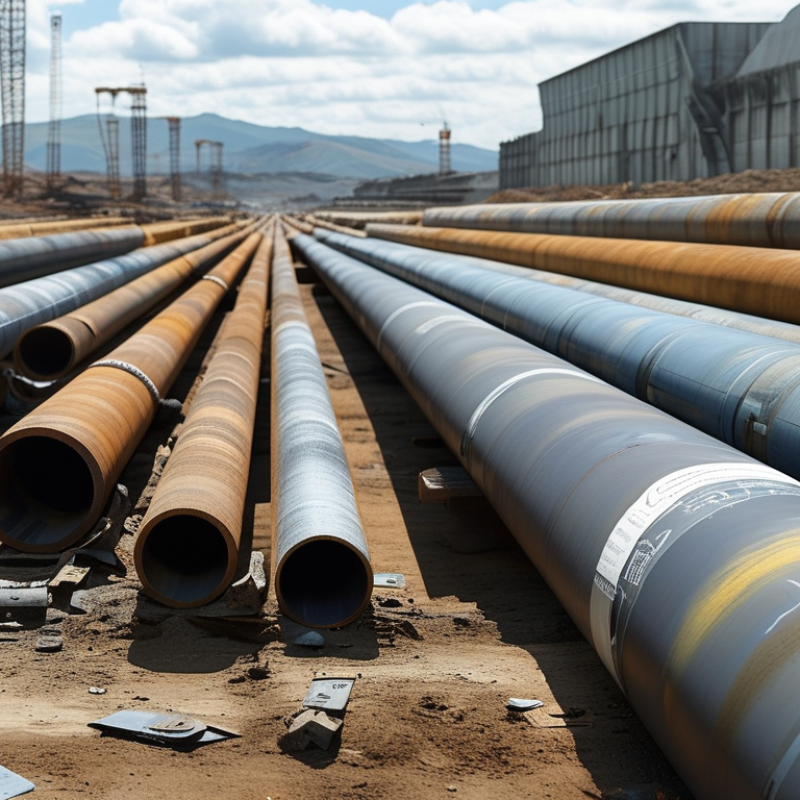
| Corrosion Protection | Protection can include external coatings, internal linings, corrosion allowance, cathodic protection compatibility, or corrosion-resistant alloy selection. | Common systems include fusion-bonded epoxy, three-layer polyethylene or polypropylene, liquid epoxy, and cement-mortar lining, selected for the service environment. | The protection system can be matched to soil, seawater, humidity, chemicals, operating temperature, and buried or above-ground exposure. |
| Testing and Inspection | Inspection plans can combine chemical analysis, tensile testing, hydrostatic testing, dimensional checks, visual examination, and non-destructive testing. | Non-destructive methods may include ultrasonic, radiographic, magnetic-particle, or dye-penetrant testing, depending on the product and specification. | Documented inspection supports traceability, quality assurance, regulatory review, and acceptance by international project stakeholders. |
| Applicable Standards | The pipe is manufactured and tested to the standard or combination of standards specified by the project. | Common international references include ISO, ASTM, ASME, EN, and API standards, with the exact document determined by the application. | Standard alignment reduces approval risk and improves compatibility with engineering, procurement, and construction requirements. |
| Typical Applications | Custom steel pipe is used for fluid transport, piles, structural columns, water systems, energy infrastructure, and industrial process lines. | Applications may involve water, gas, oil, steam, slurry, chemicals, foundations, bridges, ports, and offshore structures. | One material family can support diverse infrastructure needs while allowing the specification to change with the service environment. |
| Logistics and Project Integration | Products can be supplied with defined lengths, bundle markings, protective packaging, inspection records, and delivery sequencing. | Steel density is approximately 7,850 kg/m³; pipe weight varies with diameter, wall thickness, length, and coating. | Planned dimensions, marking, and documentation simplify international shipping, customs review, site storage, lifting, and installation control. |



 08045479132
 Send Inquiry

 Send Inquiry
 Send SMS