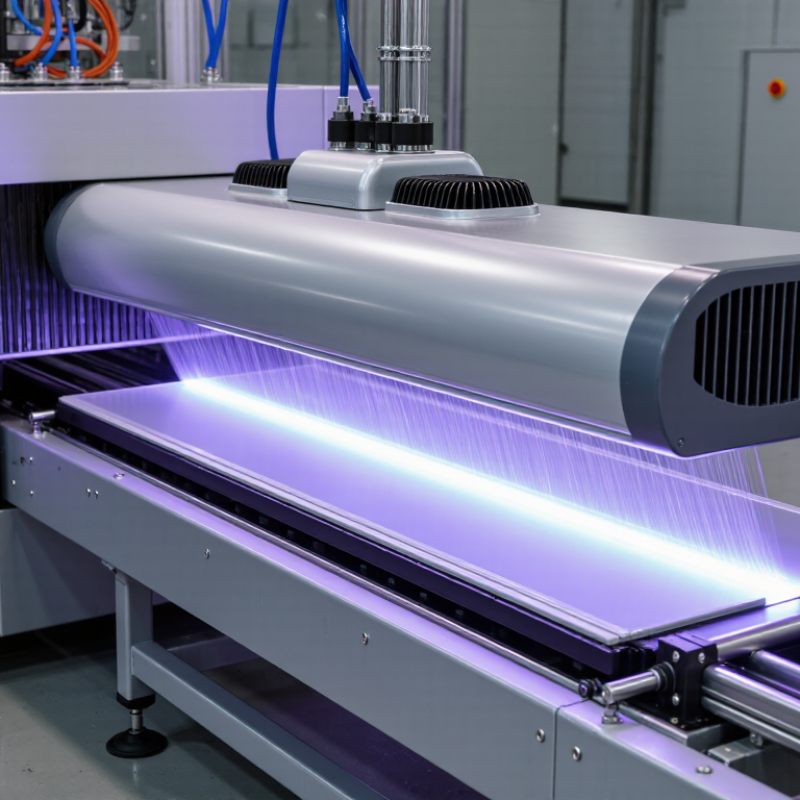
| What It Is | An ultraviolet curing lamp system that uses forced air to remove heat from the lamp housing and surrounding components. | Choose an air-cooled design when the application needs UV curing without a dedicated water chiller or water circulation system. | Air cooling removes heat from the equipment; it does not eliminate heat generated by UV curing. |
| UV Wavelength | Common curing bands include UVA at approximately 315–400 nm, UVB at 280–315 nm, and UVC at 100–280 nm. | Match the lamp spectrum to the photoinitiator or coating response. Many industrial UV-curing processes primarily use UVA output, often around 320–400 nm. | The correct wavelength depends on the ink, adhesive, coating, substrate, and required cure depth. |
| Lamp Type | Common technologies include medium-pressure mercury lamps, metal-halide lamps, and UV LED systems. | Use a broad-spectrum arc lamp for processes requiring a wider UV output range. Consider UV LEDs when the chemistry is designed for a narrow wavelength and low heat input. | Arc lamps and LEDs have different spectra, operating temperatures, control systems, and maintenance requirements. |
| Electrical Power | Industrial UV curing units commonly range from hundreds of watts to several kilowatts per lamp module. | Select power based on line speed, coating thickness, exposure distance, material absorption, and the target dose—not power alone. | Higher electrical power does not always produce a better cure if the spectrum or exposure geometry is unsuitable. |
| UV Dose | Dose is expressed in mJ/cm² and equals irradiance multiplied by exposure time. | Use a radiometer to verify the dose required by the coating or adhesive supplier. Increase dose through higher irradiance, longer exposure, or slower line speed. | The required dose varies widely by formulation, color, opacity, film thickness, and substrate. |
| Irradiance | Irradiance is the UV power received per unit area, normally measured in W/cm² or mW/cm². | Choose sufficient peak irradiance for the required cure speed and depth, then confirm uniformity across the working width. | A high peak reading at one point does not guarantee consistent curing over the complete product surface. |
| Cooling Method | Forced-air systems use fans, ducts, filters, and heat-resistant lamp housings to transport heat away from the unit. | Choose adequate airflow and ventilation for the lamp power, installation space, ambient temperature, and duty cycle. | Blocked filters, insufficient airflow, or excessive ambient temperature can shorten lamp life and reduce output. |
| Cooling Capacity | Cooling requirements depend on lamp power, optical losses, enclosure design, operating time, and ambient conditions. | Check the supplier’s specified airflow, maximum ambient temperature, exhaust temperature, and allowable continuous operating period. | Do not estimate cooling capacity from lamp wattage alone; the complete housing and ventilation path must be evaluated. |
| Working Distance | The distance between the lamp window and the curing surface strongly affects irradiance and temperature. | Use the recommended focal or working distance and confirm the result with dose and irradiance measurements at the actual production position. | Increasing distance generally reduces received intensity and may increase the time needed to reach the target dose. |
| Cure Speed | Production speed depends on UV dose, irradiance, exposure width, coating chemistry, and material handling. | For conveyor applications, select a lamp with sufficient effective curing width and output for the required line speed. | The fastest nominal line speed may not provide complete surface and through-cure on thick or pigmented materials. |
| Heat Sensitivity | Air-cooled arc lamps can transfer heat to the product through infrared radiation, hot air, and the lamp housing. | For heat-sensitive plastics, films, electronics, or thin substrates, use shielding, dichroic reflectors, optimized airflow, or a suitable LED system where compatible. | Thermal testing should be performed on the actual substrate under continuous production conditions. |
| Lamp Service Life | Arc-lamp service life is commonly measured in the low thousands of operating hours, depending on lamp type and operating conditions. | Choose a system with documented output stability, hour tracking, and a practical lamp replacement procedure. | Useful life is reached when output falls below the process requirement, not only when the lamp stops operating. |
| Reflector and Optics | Reflectors and optical windows direct UV energy toward the work surface and influence uniformity and heat transfer. | Select optics according to the required curing width, working distance, UV spectrum, and thermal limits of the product. | Dust, coating deposits, scratches, or reflector degradation can reduce UV output and create uneven curing. |
| Maintenance | Routine tasks include cleaning or replacing air filters, inspecting fans, cleaning the lamp window, and checking reflectors and electrical connections. | Choose a design that provides safe access to consumable parts and clear maintenance intervals. | Maintenance must be performed with the system isolated from electrical power and UV exposure. |
| Operating Environment | Performance is affected by ambient temperature, dust, humidity, ventilation, and available installation space. | Confirm the permitted ambient temperature, enclosure rating, air cleanliness requirements, and exhaust arrangement before installation. | Dusty or poorly ventilated environments may require additional filtration or a different cooling configuration. |
| Safety Requirements | UV radiation can injure skin and eyes. High-voltage circuits, hot surfaces, ozone, and moving fans may also present hazards. | Use interlocked shielding, UV-blocking guards, warning labels, emergency stops, ventilation, and suitable personal protective equipment. | Never operate an exposed UV lamp without effective engineering controls and a documented safety procedure. |
| Measurement and Validation | A calibrated UV radiometer can monitor irradiance and dose at the product plane. | Establish baseline readings, measure across the full curing width, and verify results after lamp replacement or maintenance. | Instrument response must match the relevant wavelength range; readings from different instruments may not be directly comparable. |
| Best-Fit Applications | Suitable applications may include industrial coatings, printing, adhesives, electronics assembly, and surface treatment where air ventilation is practical. | Choose air cooling when the product and process can tolerate the available thermal load and the installation can provide clean, reliable airflow. | Application trials should confirm cure performance, temperature, adhesion, appearance, and long-term durability. |
| Key Buying Checklist | Spectrum, irradiance, dose, curing width, working distance, cooling airflow, heat load, service life, controls, safety, and spare parts. | Request measured performance data at the actual working distance and substrate position, together with operating and maintenance requirements. | The best lamp is the one that meets the process specification consistently, safely, and economically. |



 08045479132
 Send Inquiry

 Send Inquiry
 Send SMS