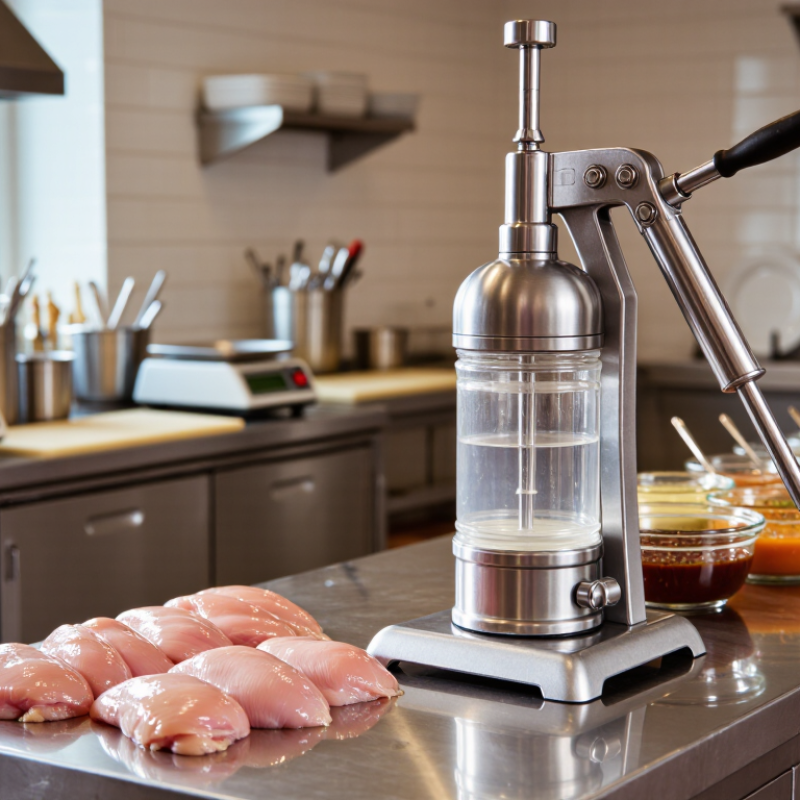
| Manual Single-Needle Injector | Small restaurants, butcher shops, test kitchens, and low-volume production | Food-grade stainless steel needle; food-contact plastic or stainless-steel reservoir and plunger | 1 needle; commonly 2–4 mm needle diameter | Approximately 30–100 ml per fill | Confirm food-contact suitability, corrosion resistance, secure needle attachment, and absence of inaccessible dead spaces | Disassemble after each use; wash with warm water and food-safe detergent, rinse, sanitize, air-dry, and store covered | Low purchase cost, easy control, minimal setup, and simple maintenance | Slow output and less uniform distribution for large batches |
| Manual Multi-Needle Injector | Small-to-medium processors requiring better coverage without compressed air | Stainless steel needles and manifold; food-grade tubing and reservoir components | 3–6 needles; interchangeable needle sizes are preferable | Approximately 100–500 ml per fill | Check that all fluid-contact parts are food-grade, removable, smooth, and resistant to brine corrosion | Remove needles, manifold, tubing, and reservoir; clean and sanitize each part separately after every production cycle | Improved coverage and higher output than a single-needle model | More parts to clean; needle blockage can reduce injection consistency |
| Pneumatic Multi-Needle Injector | Medium-to-high volume poultry processing with an existing compressed-air system | Stainless steel product-contact parts; food-grade seals, hoses, and air-line components suitable for washdown areas | Multiple needles, commonly 8–32 depending on machine size | Approximately 1–10 liters in the product reservoir | Verify pressure controls, guarding, emergency shutoff, food-contact documentation, and separation between compressed air and product | Use the validated cleaning procedure; flush product lines, remove needle assemblies, sanitize, inspect seals, and keep air fittings dry | Fast operation, repeatable injection pressure, and better productivity for continuous work | Higher purchase and maintenance costs; requires trained operators and suitable air supply |
| Electric Pump Injector | Medium-to-high volume operations needing adjustable flow and consistent dosing | Stainless steel pump and needles; food-grade hoses, gaskets, and polymer components | Single or multiple needles; configuration depends on pump capacity | Approximately 2–20 liters in the reservoir | Verify electrical protection, washdown rating, grounding, food-contact compliance, and protection against accidental startup | Disconnect power before cleaning; drain and flush the pump, dismantle product-contact parts, sanitize, and prevent water from entering electrical controls | Adjustable flow, consistent dosing, and no separate compressor required | Electrical components require careful washdown procedures and scheduled inspection |
| Continuous Conveyor Injector | Large processors handling standardized chicken portions at high throughput | Stainless steel frame and product-contact assemblies; food-grade seals and conveyor components | Multiple needle banks with adjustable height and spacing | Typically 10–50 liters or more, depending on line design | Verify guarding, interlocks, emergency stops, hygienic design, drainage, operator access, and documented hazard controls | Requires a documented sanitation program, full line disassembly where designed, validated chemical concentration, rinse control, and sanitation verification | Highest throughput, consistent coverage, and integration with automated production lines | High capital cost, larger footprint, and greater training and sanitation requirements |



 08045479132
 Send Inquiry

 Send Inquiry
 Send SMS