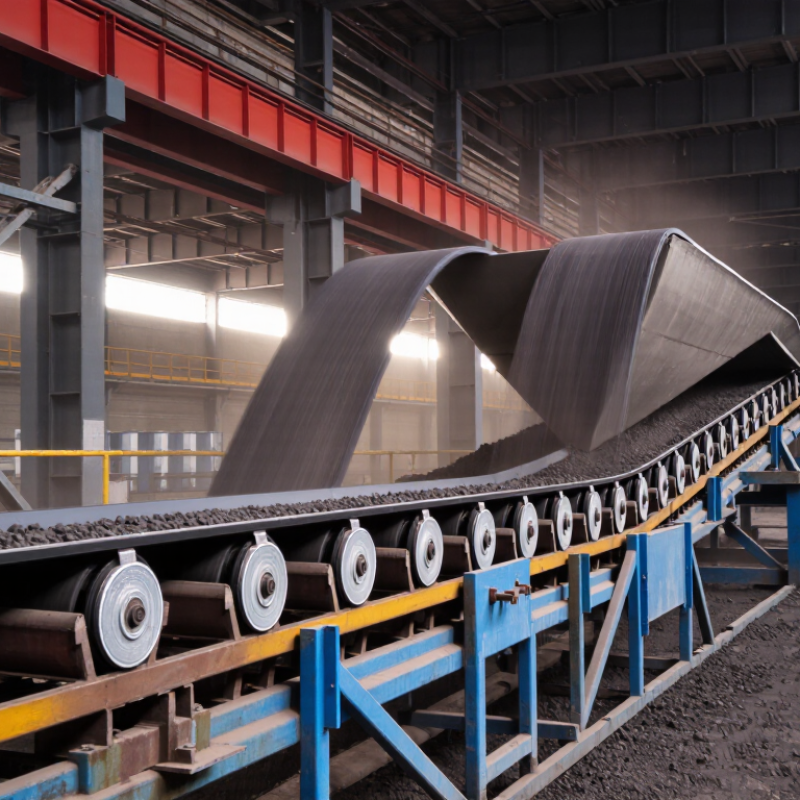
| Flat-to-Trough Transition | Conveyor head or tail sections where the belt changes between a flat profile and a troughed carrying profile | Idlers progressively change the belt cross-section from flat to the specified trough angle, or back again. | General bulk-material conveyors carrying aggregates, grain, fertilizer, or similar free-flowing materials | Transition distance must be selected for the belt construction, belt tension, pulley diameter, and trough angle. An abrupt change can increase edge strain and belt stress. |
| Long, Gradual Trough Transition | Higher-tension systems and conveyors with deep troughing | A longer transition distributes the change in belt shape over more idler stations. | Heavy-duty conveying, long-distance runs, and applications where reducing localized belt strain is important | Requires additional conveyor length and correctly aligned idlers. The belt manufacturer's transition recommendations should be checked during design. |
| Short, Space-Constrained Transition | Compact transfer points or conveyor layouts with limited structural space | A shorter transition changes the belt profile over a smaller distance. | Light-duty or lower-tension applications where layout constraints prevent a longer transition | Short transitions can increase belt-edge stress, especially with large trough angles or stiff belt carcasses. Confirm suitability with belt-design calculations rather than choosing by space alone. |
| Transition at a Loading Zone | Feed points where material is deposited onto a belt near the start of its carrying run | The belt is brought into its carrying shape in coordination with the loading chute and impact-support arrangement. | Bulk-material handling where the material needs to be centered and contained after loading | Allow the belt to reach a stable trough before relying on its full carrying capacity. Coordinate chute width, impact support, skirt sealing, and belt tracking. |
| Transition at a Discharge or Head Pulley | Discharge sections where the troughed belt must flatten as it approaches a pulley | Idler geometry gradually returns the belt to a flatter profile before the belt bends around the pulley. | Conveyors discharging into chutes, hoppers, or downstream equipment | Provide adequate transition distance and ensure the belt is sufficiently flat for the intended discharge and pulley arrangement. Check clearance and material-release behavior. |
| Special-Purpose Transition for Steep-Trough or High-Tension Service | Conveyors with demanding loading, tension, or belt-profile requirements | Transition geometry and idler positions are designed for the specific belt, operating tension, and trough configuration. | Engineered systems where standard transition arrangements may not provide acceptable belt life or tracking | Use project-specific calculations and belt supplier guidance. Consider carcass type, splice, operating conditions, pulley diameters, and support structure. |



 08045479132
 Send Inquiry

 Send Inquiry
 Send SMS