| Traction Force Range | Adjustable lumbar or pelvic traction force suitable for the intended patient population. | Many clinical tables provide approximately 20–200 lb (9–91 kg) of adjustable traction force, depending on design. | Review the technical datasheet, operating manual, and third-party load-test documentation. | High |
| Control Technology | Digital control of force, treatment time, ramp-up, hold, release, and emergency stop functions. | Programmable treatment cycles and a handheld or integrated controller are common features on powered systems. | Request a live demonstration and confirm that displayed values match measured output. | High |
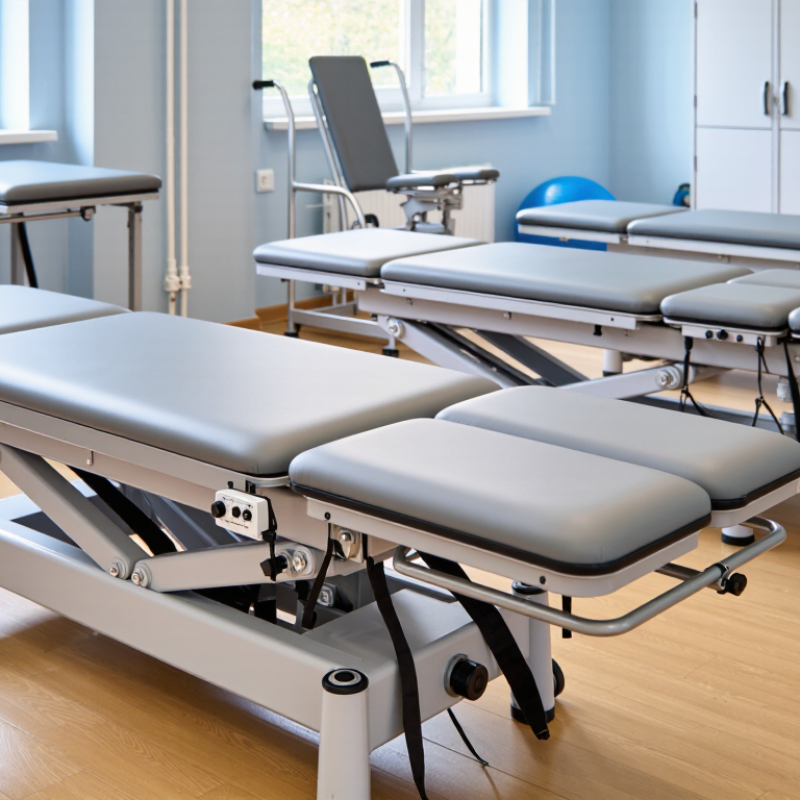
| Table Configuration | Number of sections, motorized movement, pelvic tilt, flexion capability, height adjustment, and patient positioning. | Two- to five-section designs are available; powered height adjustment is common on premium clinical models. | Compare movement diagrams, maximum angle specifications, and usable treatment-area dimensions. | High |
| Patient Safety | Emergency release, mechanical stops, patient restraint compatibility, stable frame, and overload protection. | Emergency-stop controls and defined maximum patient weight are expected for powered medical equipment. | Check risk-management files, safety-test reports, warning labels, and the stated safe working load. | Critical |
| Electrical Compliance | Compatibility with the destination country's voltage, plug configuration, electromagnetic compatibility, and electrical safety requirements. | Common supply options include 100–120 V or 220–240 V AC at 50/60 Hz, subject to the configured model. | Confirm the product label, declaration of conformity, test reports, and local regulatory requirements before purchase. | Critical |
| Load Capacity | Maximum patient weight, frame stability, lifting capacity, and operating load under repeated clinical use. | Typical rated patient capacities are approximately 350–600 lb (159–272 kg), varying by model and configuration. | Review the safe working load rather than the static frame load and request applicable test evidence. | Critical |
| Materials and Upholstery | Frame corrosion resistance, upholstery durability, cleaning compatibility, seam quality, and replacement-part availability. | Powder-coated or coated steel frames and medical-grade, fluid-resistant vinyl upholstery are widely used. | Request cleaning instructions, upholstery specifications, warranty exclusions, and replacement-cover pricing. | Medium |
| Regulatory Documentation | Quality-system evidence, technical file availability, labeling, instructions for use, and market-specific medical-device documentation. | Documentation requirements differ by jurisdiction; ISO 13485 certification may support a medical-device quality-management evaluation but does not replace local approval. | Validate certificates directly with the issuing body and confirm registration requirements with the importing authority. | Critical |
| Purchase Cost | Equipment price, accessories, installation, freight, customs, local taxes, and commissioning expenses. | Indicative market pricing commonly ranges from about US$3,000–US$15,000 for powered clinical traction tables, excluding some delivery and regulatory costs. | Compare itemized quotations using the same configuration, delivery terms, warranty, and accessory list. | High |
| Total Cost of Ownership | Preventive maintenance, calibration, consumables, replacement parts, software, downtime, and service travel. | A lower purchase price may result in higher long-term costs if parts, calibration, or local service are difficult to obtain. | Request a five-year ownership estimate and a written spare-parts price list. | High |
| Warranty Coverage | Coverage period for frame, motors, electronics, upholstery, labor, and shipping of warranty parts. | One-year limited warranty coverage is common; longer frame or selected-component coverage may be offered separately. | Read the complete warranty terms, exclusions, response obligations, and claim procedure. | High |
| Installation and Training | On-site assembly, operator training, preventive-maintenance instruction, and clinical-use guidance. | Remote setup support is common for standard shipments; on-site installation may be available at additional cost. | Obtain a written delivery-and-training scope, including estimated setup time and staff competency records. | Medium |
| Technical Support | Response channels, troubleshooting capability, service hours, remote diagnostics, and escalation process. | Email and telephone support are common; response-time commitments vary considerably by supplier and region. | Ask for service-level targets, support contact details, escalation contacts, and sample troubleshooting procedures. | High |
| Spare Parts and Serviceability | Availability of motors, controllers, cables, restraints, upholstery, fuses, and mechanical components. | Suppliers with documented parts catalogs and service manuals generally provide more predictable maintenance planning. | Confirm parts lead times, supported service life, local technicians, and whether proprietary components are used. | High |
| Delivery and Logistics | Production lead time, packaging, shipping dimensions, delivery terms, installation access, and damage-claim process. | Lead times vary by configuration and inventory; custom electrical specifications or accessories may extend production time. | Request a confirmed production schedule, packed dimensions, gross weight, Incoterms, and inspection checklist. | Medium |
| Supplier Assessment | Manufacturing experience, quality controls, reference installations, complaint handling, and capacity to support the destination market. | A documented quality process, traceable production records, and verifiable customer references reduce procurement risk. | Conduct a supplier questionnaire, request independent references, and audit documents before placing a large order. | Critical |



 08045479132
 Send Inquiry

 Send Inquiry
 Send SMS
