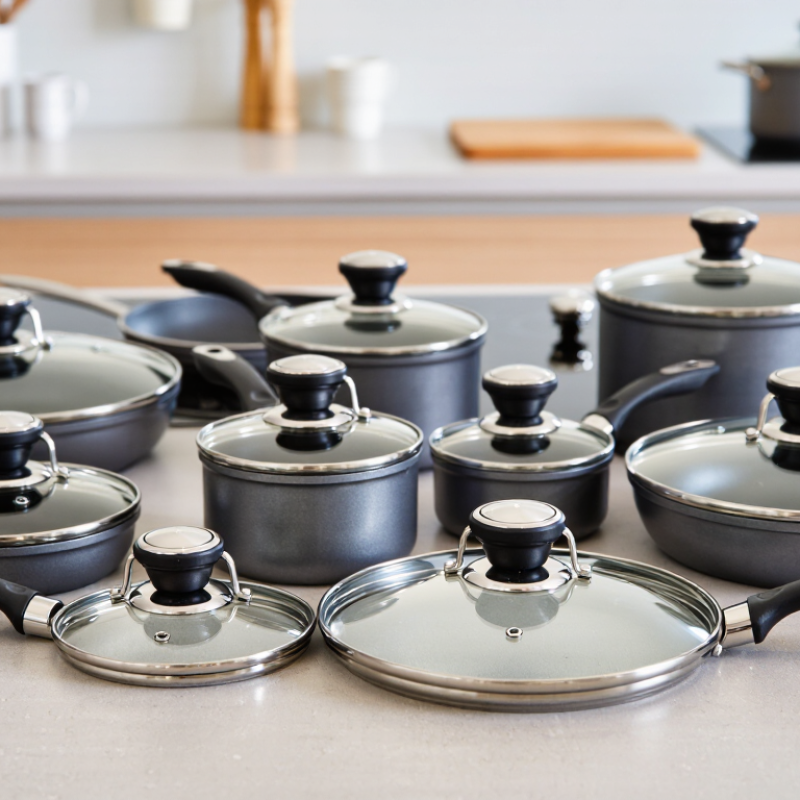
| 1 | Tempered Borosilicate Glass Lid | Flat or slightly domed glass with a stepped rim, commonly designed to cover several saucepan diameters. | Suitable when manufactured from food-contact glass and properly tested. The finished article should be free from harmful migration and should comply with applicable FDA food-contact requirements for its composition, coatings, sealants, and handle materials. | Must comply with Regulation (EC) No 1935/2004, including inertness and traceability requirements. EU national rules may apply because glass is not covered by one fully harmonized material-specific measure. | Often suitable for stovetop simmering and oven use, depending on the manufacturer’s validated temperature rating. Avoid thermal shock. | Excellent visibility, good resistance to staining and odors, and relatively low thermal expansion compared with ordinary glass. | Can break from impact or sudden temperature change; the rim, knob, and vent may be the compliance-critical components. | Everyday cooking where monitoring boiling, simmering, and reduction is important. |
| 2 | Tempered Soda-Lime Glass Lid | Transparent tempered glass with a broad stepped rim or adjustable silicone edge for multiple pan sizes. | Generally appropriate for food contact when the glass, edge seal, coatings, and handle meet applicable FDA requirements. Food-contact declarations and migration or extractives testing should cover the complete finished lid. | The complete lid must satisfy Article 3 of Regulation (EC) No 1935/2004. Ceramic- or glass-related national requirements and heavy-metal release testing may be relevant depending on decoration or composition. | Commonly rated for stovetop use; oven limits vary significantly and are usually lower when silicone or plastic parts are attached. | Widely available, clear, easy to clean, and usually less expensive than borosilicate glass. | More sensitive to rapid temperature changes than borosilicate glass; chips and scratches can weaken the rim. | General-purpose universal coverage for standard household saucepans. |
| 3 | Stainless Steel 304 Lid | Domed or flat one-piece lid, sometimes with a rolled edge and a central steam vent. | Food-contact use is common when the alloy, surface finish, welding, and attached components are suitable. Compliance should be confirmed for the finished article, especially where nickel release, coatings, or elastomeric parts are present. | Must meet Regulation (EC) No 1935/2004 and applicable national requirements for metals and alloys. EU member states may apply different metal-release limits because there is no single comprehensive EU metals measure. | Typically suitable for high stovetop temperatures and many oven applications when no heat-sensitive trim is used. | Durable, opaque, corrosion-resistant, dishwasher-friendly, and less prone to breakage than glass. | No visibility into the pan; can become hot quickly and may create condensation drips when lifted. | Heavy-duty cooking, commercial-style kitchens, and users prioritizing durability over visibility. |
| 4 | Stainless Steel 316 Lid | Universal flat or domed lid made from a molybdenum-containing stainless-steel grade, usually with a rolled rim. | Appropriate only when the selected alloy and finished product satisfy applicable FDA food-contact requirements. The supplier should document composition, corrosion resistance, and the suitability of any handle, rivet, or coating. | Covered by the general safety requirements of Regulation (EC) No 1935/2004, plus applicable national metal and alloy rules. Migration or release testing should reflect the intended food types and use conditions. | High-temperature stovetop use is typical; oven suitability depends on the handle, seal, and design. | Better resistance to chloride-containing environments than many common stainless-steel grades; robust and long-lasting. | Usually heavier and more costly than 304 stainless steel; still blocks visual monitoring. | Frequent cooking with salty or acidic foods and demanding commercial or outdoor environments. |
| 5 | Food-Contact Silicone Universal Lid | Flexible silicone disc or dome with concentric sealing rings that stretch over several saucepan diameters. | Silicone rubber may be used for food contact when it meets applicable FDA requirements, commonly including 21 CFR 177.2600 where relevant to the formulation and use. Extractives testing should cover repeated contact, hot foods, and the actual formulation. | Must comply with Regulation (EC) No 1935/2004. Silicone-specific EU requirements can also depend on national measures, and the finished product must meet applicable overall safety and migration expectations. | Often suitable for hot stovetop use, but the maximum temperature must be confirmed for the exact silicone grade and design. Direct contact with a burner is unsuitable. | Flexible, lightweight, space-saving, quiet, and effective for covering multiple pan sizes. | Can retain odors, attract dust, deform if overheated, and may not provide a rigid steam-management structure. | Storage-saving kitchens, microwave covering, resting food, and short-term simmering protection. |
| 6 | Glass Lid with Silicone Sealing Rim | Transparent tempered glass center combined with a flexible silicone rim intended to fit several diameters. | Both the glass and silicone must be suitable for food contact. FDA documentation should address the complete assembly, including pigments, adhesives, vent components, and any polymer insert. | The complete assembly must satisfy Regulation (EC) No 1935/2004 and relevant EU or national measures for glass, silicone, pigments, and other components. | Usually limited by the silicone rim, knob, and vent rather than the glass itself; oven use must follow the lowest-rated component. | Combines visibility with a forgiving seal; accommodates small differences in saucepan diameter. | More parts mean more cleaning interfaces; silicone may discolor or age faster than the glass. | Users wanting visibility and broad compatibility without a rigid metal rim. |
| 7 | Enameled Steel Lid | Steel substrate covered by a glassy vitreous-enamel surface, usually with a rolled or stepped edge. | The enamel coating and underlying metal must be suitable for food contact under intended conditions. Testing should consider metal release, coating integrity, chips, pigments, and any exposed rim or handle material. | Must comply with Regulation (EC) No 1935/2004. Ceramic-type requirements, including restrictions on the release of lead and cadmium where applicable, should be considered for the enamel surface and decoration. | Generally suitable for stovetop use; oven capability depends on the exposed metal, knob, and coating design. | Opaque, durable, resistant to staining, and often more decorative than plain steel. | Chipped enamel can expose the substrate; impact and rapid temperature changes may damage the coating. | Long-term household use where appearance and stain resistance are valued. |
| 8 | Anodized Aluminum Lid | Lightweight formed aluminum lid with an anodized surface, often paired with a stainless-steel or polymer knob. | The anodized surface, alloy, coatings, and attached components require product-specific evaluation. The manufacturer should verify that the coating remains intact and that aluminum or other constituents do not migrate above applicable limits. | Regulation (EC) No 1935/2004 applies, but aluminum requirements may also depend on national rules and intended use. Testing should address acidic and salty foods, abrasion, and coating durability. | Usually suitable for stovetop use; oven limits depend strongly on the knob, seal, and surface treatment. | Very light, quick to handle, and resistant to some forms of surface corrosion when properly anodized. | Scratches or harsh abrasion may damage the anodized layer; aluminum can discolor or react if the protective surface is compromised. | Lightweight cookware sets and users who prefer easy lifting. |
| 9 | Food-Contact Polypropylene Lid | Rigid or semi-rigid plastic lid with concentric steps, often intended for covering several pan or container diameters. | Polypropylene used for food contact generally needs to comply with applicable FDA polymer requirements, commonly including 21 CFR 177.1520 when relevant. Colorants, additives, seals, and repeated-use conditions must be included in the compliance assessment. | Must comply with Regulation (EC) No 1935/2004 and, when applicable, Regulation (EU) No 10/2011 for plastic food-contact materials. A declaration of compliance and migration testing should cover the intended food and temperature conditions. | Often suitable for cool storage or microwave use when specifically rated; commonly unsuitable for direct stovetop heat and many ovens. | Lightweight, inexpensive, stackable, and resistant to impact compared with glass. | Lower heat resistance than glass or metal; may warp, absorb odors, or discolor if used outside its rating. | Storage, reheating, and temporary covering rather than active stovetop simmering. |
| 10 | Ceramic or Stoneware Lid | Rigid glazed ceramic cover, sometimes with a broad lip designed to rest on multiple saucepan sizes. | The glaze, pigments, body, and handle must be evaluated as a complete food-contact article. Particular attention is needed for lead and other heavy-metal release from glaze or decoration. | Must comply with Regulation (EC) No 1935/2004 and applicable EU requirements for ceramic articles, including lead and cadmium release limits under Directive 84/500/EEC as amended. | Heat capability varies widely; thermal-shock resistance and maximum oven temperature must be specifically validated. | Good heat retention, attractive appearance, and resistance to staining when the glaze is intact. | Heavy, breakable, less universally adjustable, and vulnerable to thermal shock or edge chipping. | Slow cooking, serving, and heat-retaining applications where weight is acceptable. |



 08045479132
 Send Inquiry

 Send Inquiry
 Send SMS