| Portable handheld meter | Uses a probe immersed in a sample; commonly displays conductivity and may also calculate TDS or salinity. | Ranges vary by model and probe, from low-conductivity water measurements to high-conductivity solutions. | Field water testing, aquaculture, agriculture, cooling-tower checks, and routine wastewater sampling. | Check measurement range, temperature compensation, probe durability, ingress protection, and calibration options. |
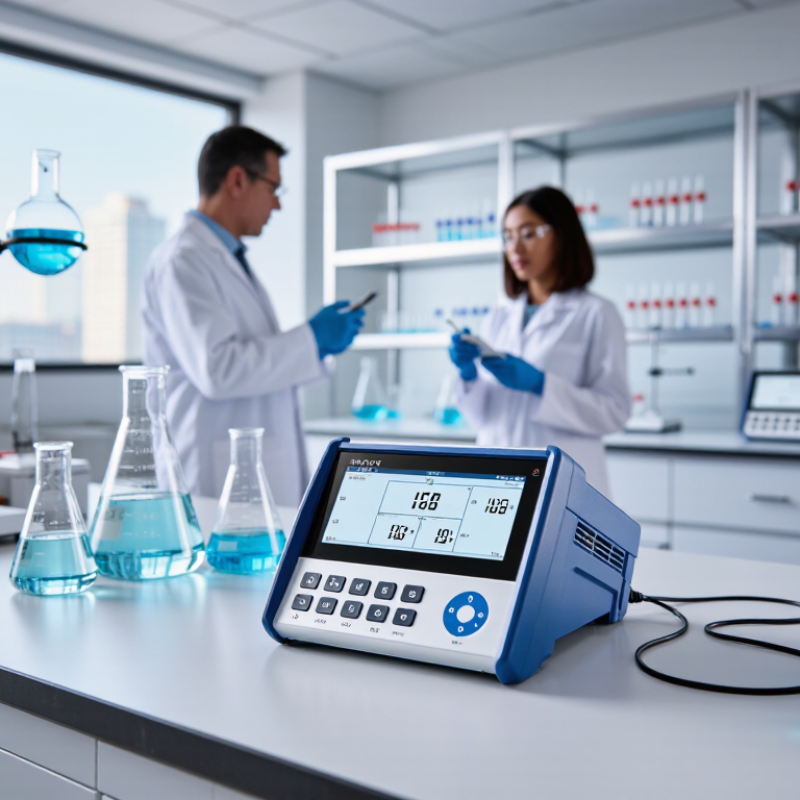
| Benchtop conductivity meter | Measures a sample in a laboratory cell, often with automatic temperature compensation and data functions. | Available with cells suited to low, medium, or high conductivity; the cell constant affects the suitable range. | Water-quality laboratories, education, food and beverage testing, and quality-control laboratories. | Consider accuracy, repeatability, supported cell constants, temperature-probe compatibility, and data export. |
| Inline contact sensor and transmitter | Electrodes contact the process liquid; a transmitter provides continuous readings and process outputs. | Selected according to the sensor cell constant and process conditions; available for different conductivity ranges. | Water treatment, chemical processing, rinse-water monitoring, and industrial process control. | Confirm process connection, materials compatibility, pressure and temperature limits, cleaning needs, and output protocol. |
| Inductive (toroidal) conductivity meter | Measures conductivity without exposed electrodes, using electromagnetic coupling through the liquid. | Best suited to applications with sufficiently conductive liquids; the usable range depends on the sensor design. | Corrosive or fouling process streams, chemical production, and wastewater applications. | Useful where electrode coating or corrosion is a concern; verify minimum conductivity and installation requirements. |
| Pure-water conductivity system | Uses a low-cell-constant probe and temperature measurement to assess very low ionic conductivity. | Designed for low-conductivity water; performance depends on probe design, flow conditions, temperature, and handling. | Pharmaceutical water systems, laboratory water, power-generation water, and semiconductor process water. | Choose a system designed for low-conductivity samples and minimize contamination from air exposure, tubing, and sample containers. |
| Resistivity meter | Reports electrical resistivity, which is inversely related to conductivity for the same measurement conditions. | Commonly used for high-purity water; ultrapure water has a theoretical resistivity of about 18.2 MΩ·cm at 25°C. | Ultrapure-water monitoring, pharmaceutical utilities, and electronics manufacturing. | Check temperature reference, low-range performance, sensor placement, and whether the system reports conductivity, resistivity, or both. |
| TDS or salinity meter | Typically estimates total dissolved solids or salinity from conductivity using a conversion factor or selected scale. | Displayed results depend on the instrument’s conversion factor, calibration, sample composition, and temperature correction. | Hydroponics, aquaculture, drinking-water screening, agriculture, and general field checks. | TDS is an estimate rather than a direct measurement of all dissolved substances; select a conversion setting appropriate to the application. |



 08045479132
 Send Inquiry

 Send Inquiry
 Send SMS