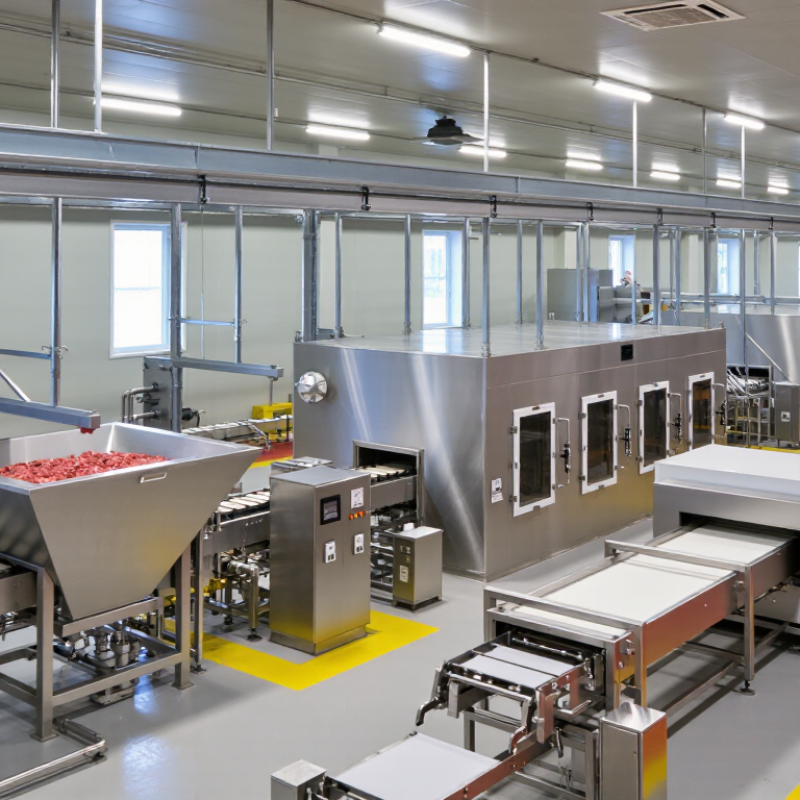
| Raw Material Receiving | Receiving hopper, belt conveyor, weighing system | Fish or fish-processing by-products are weighed, inspected, and transferred continuously or in batches. | Throughput commonly selected from approximately 1 to 20 tonnes of raw material per hour. | Corrosion-resistant construction, hygienic design, feeding stability, and easy cleaning. |
| Size Reduction | Crusher, cutter, or fish pre-breaker | Large fish and solid pieces are reduced to a more uniform size to improve heat transfer and pressing performance. | Particle size is adjusted according to raw material type and cooker design. | Blade durability, overload protection, replaceable wear parts, and safe access. |
| Cooking | Steam cooker or indirect-heated cooker | Heat coagulates proteins, breaks cell structures, releases oil, and prepares the material for liquid-solid separation. | The fish mass is commonly heated to about 90–100°C; residence time depends on raw material and capacity. | Uniform heating, temperature control, steam consumption, insulation, and anti-blocking design. |
| Pressing | Twin-screw press or screw press | Mechanical pressure separates the cooked material into press liquor and a solid press cake. | The press cake typically leaves with approximately 40–55% moisture, depending on material and machine settings. | Cake moisture, oil recovery, screw wear resistance, adjustable compression, and motor efficiency. |
| Liquid Separation | Decanter centrifuge, screen, or settling system | Fine solids are separated from press liquor before oil and water clarification. | Separation performance depends on feed solids, temperature, flow rate, and centrifuge settings. | Solids capture, oil loss, automatic control, vibration protection, and maintenance access. |
| Drying | Rotary dryer, disc dryer, or indirect steam dryer | Moisture is removed from the press cake while limiting excessive heat exposure that can reduce protein quality. | Finished fish meal is commonly dried to approximately 6–10% moisture, subject to product specifications. | Energy consumption, final moisture uniformity, product temperature, residence-time control, and odor containment. |
| Grinding and Screening | Hammer mill, pin mill, and vibrating screen | Dried material is milled and screened to create a consistent particle-size distribution. | Screen openings are selected according to customer and feed-industry requirements. | Particle-size consistency, dust control, mill wear, noise level, and screen replacement time. |
| Oil Recovery | Centrifugal oil separator and polishing unit | Separated liquid is clarified into fish oil, stickwater, and fine solids for recovery or further concentration. | Actual oil yield varies significantly with species, freshness, fat content, and process control. | Oil clarity, recovery rate, wastewater load, automatic discharge, and food-grade contact materials. |
| Odor and Emission Control | Cyclone, condenser, scrubber, biofilter, or thermal treatment unit | Process vapors and non-condensable gases are collected, condensed, scrubbed, or biologically treated before discharge. | The required configuration depends on local environmental limits and plant location. | Capture efficiency, pressure stability, corrosion resistance, monitoring points, and regulatory compliance. |
| Automation and Utilities | PLC control panel, sensors, steam system, pumps, and conveyors | Sensors regulate temperature, pressure, flow, motor load, and moisture-related process variables throughout the line. | Control architecture may range from semi-automatic operation to fully integrated PLC and HMI systems. | Spare-parts availability, documentation, remote support, electrical standards, and operator training. |



 08045479132
 Send Inquiry

 Send Inquiry
 Send SMS
