| Food Conveyor X-ray Inspection | Packaged food, frozen products, meat, seafood, bakery products and ready meals | Uses two X-ray energy levels to compare material absorption and improve separation between organic products and dense foreign materials | Sanitary conveyor with a compact inspection tunnel; product spacing and shielding are designed for continuous production lines | Organic vs. inorganic materials | Metal, glass, stone, calcified bone, dense plastic, rubber and missing or broken product components | Usually specified in packs per minute or metres per minute; the actual rate depends on product size, spacing and image-processing time | Hygienic construction, washdown rating, reject accuracy, false-reject rate, line integration and food-safety compliance |
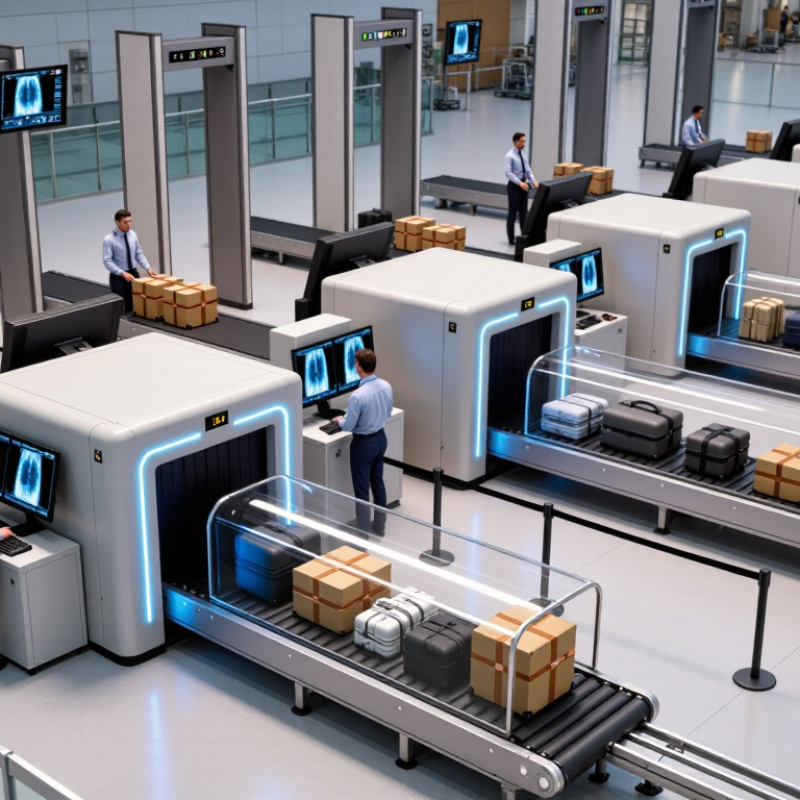
| Parcel and Baggage Inspection | Courier parcels, postal items, cabin baggage and checked baggage | Produces colour-coded or material-classified images that help operators distinguish low-, medium- and high-density contents | Horizontal conveyor tunnel with lead shielding, operator workstation and automatic or manual image review | Effective atomic-number classification | Organic materials, liquids, batteries, electronic devices, dense objects and prohibited items | Commonly designed for continuous belt operation; throughput is determined by conveyor speed, tunnel size and security workflow | Image quality, penetration, threat-detection software, network connectivity, operator ergonomics and applicable aviation or security standards |
| Pallet and Cargo Inspection | Palletized goods, air cargo, freight containers and large commercial shipments | Combines dual-energy imaging with higher-output X-ray generation to classify materials across thicker and more varied loads | Large tunnel or drive-through configuration with reinforced conveyor, cargo handling equipment or vehicle positioning area | Mixed-density cargo classification | Concealed goods, dense inorganic materials, organic substances, voids and inconsistent cargo contents | Usually measured by pallets, vehicles or containers per hour rather than individual products | Penetration capability, scanning speed, radiation safety zone, maximum load dimensions, weather protection and site infrastructure |
| Industrial Inline Inspection | Castings, extrusions, batteries, tyres, composite parts and assembled components | Uses energy-dependent attenuation differences to support automated detection and classification of internal defects | Integrated into a production cell or conveyor line; may use fixed, multi-view or robotic positioning | Density and composition differences | Voids, cracks, inclusions, porosity, foreign material, incorrect assembly and dimensional deviations | Application-specific; cycle time is determined by part geometry, number of views, required resolution and automation level | Spatial resolution, repeatability, inspection coverage, software integration, traceability and compatibility with manufacturing execution systems |
| Security Checkpoint X-ray System | Hand luggage, personal belongings, tools and small containers at controlled access points | Separates material categories in the X-ray image to support rapid operator assessment of suspicious objects | Compact conveyor tunnel with trays, dual-view options or ergonomic inspection tables | Organic and inorganic separation | Blades, firearms, liquids, batteries, dense objects and concealed prohibited articles | Selected according to passenger flow, belt width, tunnel size and the required inspection procedure | Compact footprint, image enhancement, operator training features, alarm management, maintenance access and regulatory approval |
| Research and Laboratory X-ray System | Material samples, powders, biological specimens, electronic assemblies and laboratory test pieces | Acquires images at different energy spectra to estimate material composition or improve contrast between adjacent materials | Enclosed cabinet, sample stage or precision positioning system rather than a high-speed production conveyor | Quantitative material analysis | Layer structure, density variation, contamination, inclusions, sample composition and internal morphology | Batch or sample-based operation; throughput is normally less important than resolution, repeatability and measurement control | Energy range, detector sensitivity, spatial resolution, calibration, software functions, sample size and laboratory safety controls |



 08045479132
 Send Inquiry

 Send Inquiry
 Send SMS