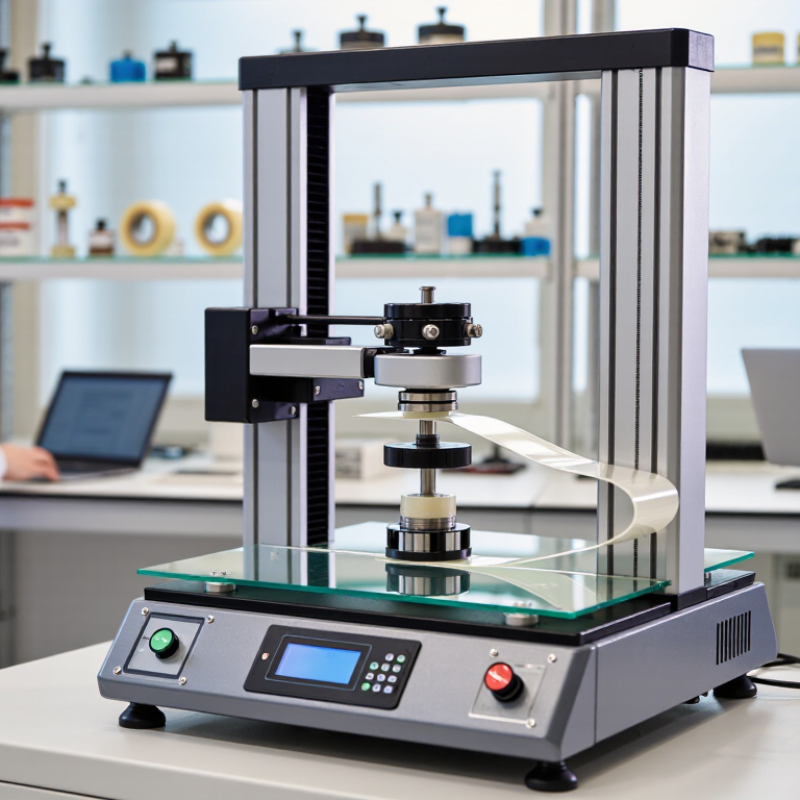
| What the instrument measures | The force required to peel a flexible material from a rigid or supported surface at an approximately 90° angle. | The result is commonly reported as peel force per unit width, such as N/25 mm, N/10 mm, or N/mm. |
| Primary test angle | 90° between the peeled flexible specimen and the bonded or supported surface. | A fixed peel angle improves repeatability and makes results comparable when specimen preparation and test speed are controlled. |
| Relevant international standard | ISO 8510-1: Adhesives — Peel test for a flexible bonded to a rigid adherend — Part 1: 90° peel. | This standard specifies a 90° peel method for flexible-to-rigid adhesive bonds. The applicable edition and laboratory procedure should be confirmed before testing. |
| Additional adhesive standard | ASTM D6862: Standard Test Method for 90 Degree Peel Resistance of Adhesives. | Useful for adhesive-bond evaluation; specimen construction, conditioning, rate, and reporting must follow the selected ASTM procedure. |
| Common test materials | Pressure-sensitive tapes, adhesive films, labels, laminates, flexible packaging structures, sealants, and bonded flexible laminates. | The fixture and gripping method should prevent stretching, tearing, wrinkling, or slippage of the flexible layer. |
| Typical specimen width | Common laboratory widths include 10 mm, 15 mm, 25 mm, and ಕೆ | The width must be stated in the test report because peel force is directly affected by specimen width. Standard-specific dimensions take priority. |
| Common reporting units | N/25 mm, N/10 mm, N/mm, N/m, or lbf/in. | Results should not be compared directly unless width, unit conversion, test rate, conditioning, and failure mode are equivalent. |
| Load-cell selection | Typical interchangeable capacities include 10 N, 50 N, 100 N, 500 N, and higher ranges, depending on the application. | Select a capacity that safely covers the expected maximum force while retaining suitable resolution in the normal measurement range. |
| Crosshead-speed capability | Motorized systems commonly provide programmable speeds across a broad range, often from low single-digit mm/min values to several hundred mm/min. | Peel force is rate-dependent. The selected speed must match the applicable standard or internal method. |
| Angle-control mechanism | A dedicated 90° peel fixture, guided roller, low-friction arm, or controlled deflection arrangement. | The mechanism should maintain the peel geometry throughout the test and minimize friction or unintended bending forces. |
| Force-measurement system | Digital load cell with continuous force acquisition and peak, average, and force-versus-distance recording. | Average peel force is often more representative than a single peak because adhesive interfaces may produce stick-slip behavior. |
| Data-acquisition functions | Real-time graphing, force averaging over a defined travel distance, peak-force capture, automatic unit conversion, and electronic result storage. | Software is valuable for repeatability studies, quality control, statistical process monitoring, and audit-ready reporting. |
| Specimen conditioning | Temperature, relative humidity, dwell time, substrate preparation, and adhesive contact pressure should be controlled and documented. | Environmental and preparation variables can significantly change adhesion results, even when the same tester is used. |
| Substrate requirements | Rigid panels or adherends with controlled surface finish, cleanliness, roughness, and material composition. | Surface contamination, oxidation, roughness, and substrate flexibility can cause variation unrelated to the adhesive formulation. |
| Failure-mode classification | Adhesive failure, cohesive failure, substrate failure, transfer, film stretching, tearing, or mixed failure. | A numerical peel value should be accompanied by a visual description or image of the failure mode. |
| Calibration and verification | Regular load-cell calibration, speed verification, fixture inspection, and angle alignment checks. | Traceable calibration and documented verification support reliable quality-control and research results. |
| Suitable laboratory environments | Packaging, converting, pressure-sensitive adhesive, automotive, electronics, medical-device, construction, and materials-testing laboratories. | The required fixture, load range, environmental chamber, and software depend on the material and production process being evaluated. |
| Worldwide supplier-evaluation criteria | Standards support, available load cells, angle stability, speed accuracy, calibration service, software functions, spare parts, training, and regional technical support. | These criteria provide a neutral basis for comparing 90° peel testers without relying only on price, advertising claims, or brand recognition. |



 08045479132
 Send Inquiry

 Send Inquiry
 Send SMS