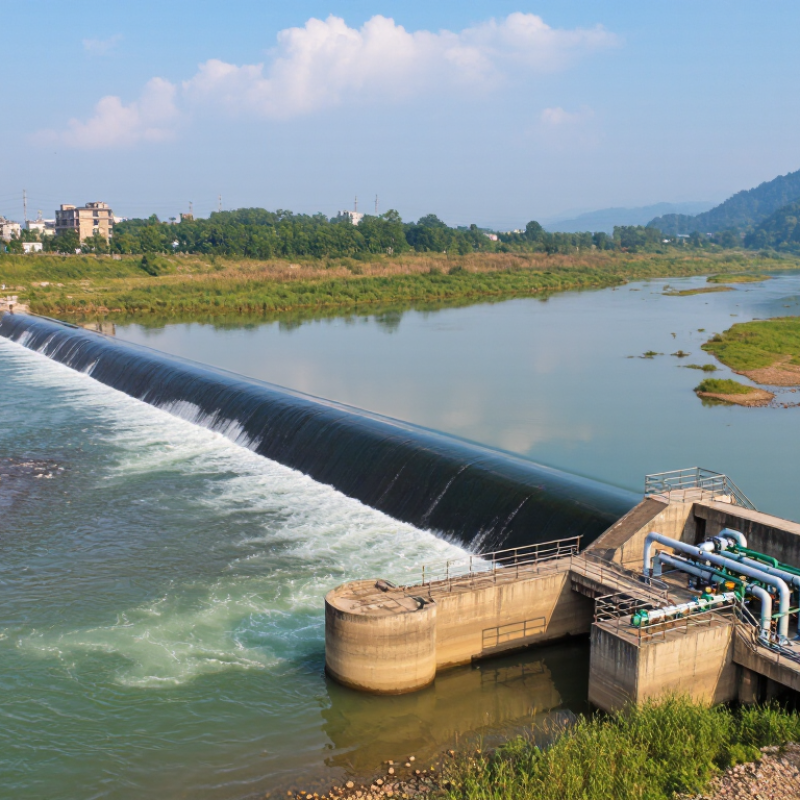
| Dam Body | Flexible reinforced-rubber membrane anchored to a concrete foundation; commonly manufactured as a single or segmented inflatable body. | Allows the crest height to change without using rigid mechanical gates across the full channel width. | Membrane abrasion, ultraviolet exposure, temperature, chemicals, and repeated flexing must be considered in material selection. |
| Typical Inflated Height | Approximately 0.5–5 m for many river, irrigation, flood-control, and small hydropower applications; larger installations require project-specific verification. | Provides adjustable upstream storage and helps maintain a target operating level during normal flow conditions. | The selected height must account for flood discharge, upstream backwater, foundation elevation, and downstream water levels. |
| Typical Crest Length | Often installed across channels from roughly 10 m to more than 100 m; length is governed by river width, abutments, and segmentation requirements. | Enables broad-channel level regulation while keeping the spillway profile comparatively low when deflated. | Long crests may need multiple cells or independent control zones to limit the effect of local damage. |
| Inflation Medium | Air-inflated systems provide rapid adjustment; water-inflated systems provide higher unit mass and are often selected where stable, gradual operation is preferred. | Supports automated or semi-automated crest adjustment in response to river level, flow, or weather conditions. | Air systems require reliable compressors and controls, while water systems require pumps, valves, filtration, and suitable water quality. |
| Automatic Deflation | Common arrangements use upstream level sensors, pressure sensors, programmable controls, emergency release valves, or hydraulic bypass systems. | Allows the dam to lower before or during high-flow events, reducing upstream flood risk when correctly designed and maintained. | The release logic must be fail-safe and coordinated with flood forecasting, sensor redundancy, power backup, and manual override procedures. |
| Foundation and Anchorage | Reinforced-concrete sill, embedded anchor bolts, clamping bars, side seals, and protected transition zones are typical components. | Transfers membrane loads to the riverbed and abutments while limiting leakage and edge uplift. | Geotechnical investigation, scour protection, uplift resistance, settlement control, and concrete durability are essential. |
| Flood-Passage Capability | Designed to operate in a fully or partially deflated condition during selected flood events; final capacity depends on channel hydraulics and freeboard. | A lowered membrane can reduce obstruction to flood flow compared with a fixed-height barrier. | Hydraulic modelling is required to check backwater, velocities, debris passage, sediment transport, and downstream scour. |
| Operating Response | Adjustment speed varies by membrane volume, inflation medium, pump or compressor capacity, valve size, and control strategy. | Enables gradual seasonal adjustment or faster emergency lowering when supported by adequately sized equipment. | Response time should be established through hydraulic calculations, full-scale commissioning tests, and emergency operating procedures. |
| Sediment and Debris Management | Design may include sediment flushing, debris booms, trash racks, low-level outlets, maintenance access, and sacrificial protection zones. | Helps preserve storage capacity, reduce abrasion, and maintain reliable movement of the membrane. | Sediment deposition and floating debris should be assessed using site surveys and seasonal flow records. |
| Durability Target | Service life is project-specific; membrane life is commonly assessed over multiple decades when exposure, inspection, and maintenance are properly managed. | A planned inspection and replacement strategy can reduce unplanned outages and lifecycle risk. | Actual life depends on compound formulation, reinforcement, operating cycles, water chemistry, abrasion, UV exposure, and maintenance quality. |
| Monitoring and Maintenance | Recommended systems typically include pressure, water-level, valve-position, leakage, and power-status monitoring, with regular visual inspections. | Early detection of pressure loss, abnormal deformation, leakage, or control faults improves operational reliability. | Inspection intervals should reflect flood exposure, debris loading, operating frequency, and the consequences of failure. |
| Environmental and Fish-Passage Measures | Possible measures include fish passages, bypass channels, seasonal drawdown, minimum downstream flows, and controlled sediment release. | Supports more responsible river-level management while reducing impacts on aquatic habitats. | Environmental requirements vary by river basin and must be confirmed through local permits, ecological studies, and operating rules. |



 08045479132
 Send Inquiry

 Send Inquiry
 Send SMS
