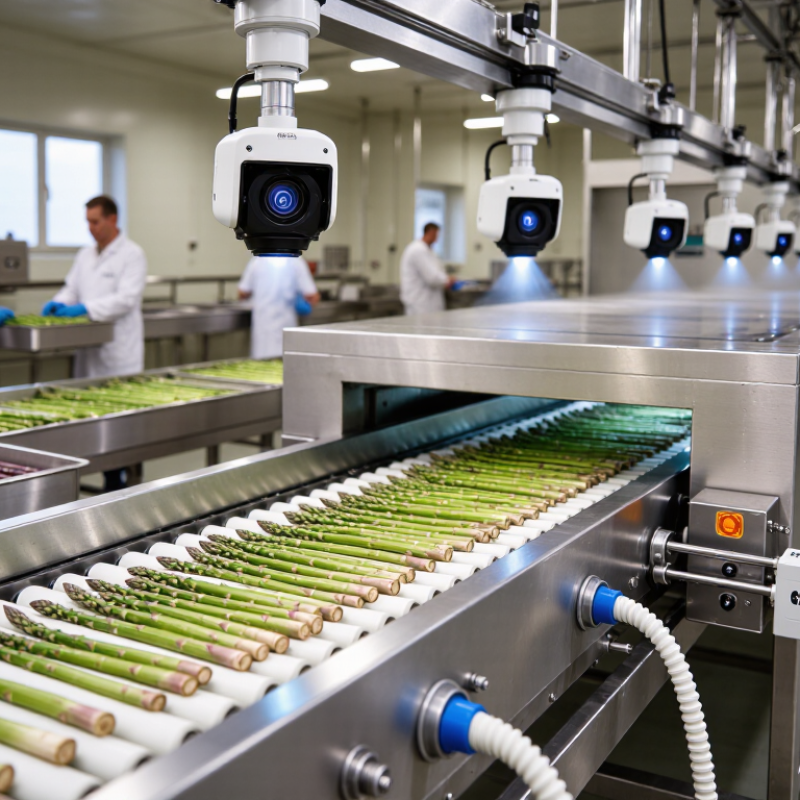
| Diameter grading | Asparagus is commonly marketed in diameter classes such as 6–9 mm, 9–12 mm, 12–16 mm, and above 16 mm, depending on the applicable customer or market specification. | Camera-based measurement can classify individual spears by visible diameter and route them into defined size grades. | More consistent packs, fewer size-mixing errors, and better alignment with customer specifications. |
| Length classification | Retail and foodservice products may require controlled spear lengths or trimmed lengths. | Vision systems can identify spear position, measure visible length, and separate products outside a configured range. | Improves pack uniformity and reduces manual checking at the grading line. |
| Color grading | Green, white, and purple asparagus require different color specifications. Green asparagus may also show pale or uneven coloration. | RGB imaging can assess dominant color, color uniformity, and visible discoloration. | Supports color-based product separation and helps maintain a consistent visual appearance. |
| Tip quality | Tips are high-value presentation areas and may be affected by damage, opening, browning, or deformation. | High-resolution imaging can inspect the tip area for visible physical defects and abnormal shape. | Protects premium grades and reduces the chance that visibly damaged tips enter finished packs. |
| Surface defects | Common visible issues include bruising, scars, cuts, discoloration, insect damage, and soil residue. | Configured image models can detect differences in color, texture, shape, and surface appearance. | Creates repeatable defect rules and reduces dependence on subjective visual inspection. |
| Foreign-material control | Field-harvested produce can contain leaves, stems, stones, soil clumps, or packaging fragments. | Optical systems can identify objects that contrast with asparagus in color, shape, or reflectance. | Adds a non-contact inspection step before packing or further processing. |
| Throughput consistency | Harvest volumes and incoming quality can vary significantly by field, cultivar, weather, and harvest timing. | Automated inspection applies programmed sorting rules continuously while product moves through the line. | Helps maintain a stable grading process during peak intake periods and changing product conditions. |
| Labor allocation | Manual sorting requires operators to perform repetitive inspection and separation tasks over extended shifts. | Automation performs the first-pass classification, allowing personnel to focus on quality verification, line control, and exception handling. | Reduces repetitive inspection work and supports more consistent decisions across shifts. |
| Hygiene and product handling | Asparagus is a fresh product that can be vulnerable to bruising and unnecessary handling. | Non-contact imaging evaluates product appearance without requiring each spear to be manually handled. | Can reduce handling points and help protect product appearance when the line is correctly configured. |
| Traceability and quality data | Processors need visibility into grade distribution, defect rates, rejected quantities, and changes in incoming quality. | Industrial sorting systems can record counts and classification results when connected to suitable line-control or data systems. | Provides objective process data for production reviews, quality control, and supplier feedback. |
| Flexible quality recipes | Different customers may set different tolerances for diameter, length, color, tip condition, and visible defects. | Sorting parameters can be configured for different product grades, pack formats, and acceptance criteria. | Makes it easier to switch between specifications without rebuilding the entire manual inspection process. |



 08045479132
 Send Inquiry

 Send Inquiry
 Send SMS