| Passive HDMI Cable | Approximately 3–5 m for reliable high-bandwidth signals; shorter distances are preferable for demanding formats | Suitable for standard HD and many 4K applications when the cable is certified for the required bandwidth | Certified high-speed or ultra-high-speed HDMI cable | Normally none beyond the source and display | Short connections between nearby devices | Check the cable’s certified bandwidth, connector quality, bend radius, and compatibility with the required resolution and refresh rate |
| Active Copper HDMI Extender | Approximately 10–15 m, depending on resolution, refresh rate, cable construction, and source strength | HD and 4K are possible; performance decreases as distance and bandwidth increase | Built-in signal-conditioning electronics with copper conductors | Some models draw power from HDMI; others require USB or an external power adapter | Medium-distance home, office, and classroom installations | Confirm whether the unit supports the target format, HDCP version, HDR, audio return, and any required external power |
| HDMI Active Optical Cable | Commonly 10–100 m, with the actual limit determined by the cable design and signal format | Can support high-bandwidth 4K and, with suitable hardware, some 8K applications | Hybrid copper-fiber cable with integrated optical conversion | Usually powered through the HDMI connection; some installations may need additional power | Long point-to-point links where low electromagnetic interference is important | Many optical HDMI cables are directional. Verify source and display ends, bend limits, connector type, and support for HDR, HDCP, and refresh rate |
| HDMI over Cat 6/6A | Up to about 70–100 m for selected 4K systems; shorter distances may be required for full-bandwidth 4K60 | Ranges from HD to 4K, depending on the extender standard, compression, chroma format, and cable length | One or two runs of solid-core Cat 6 or Cat 6A twisted-pair cable between a transmitter and receiver | Transmitter and receiver normally require external power | Permanent structured-cabling installations in homes, offices, retail spaces, and classrooms | Use shielded or unshielded cable according to the installation environment. Do not route the cable through unmanaged network equipment unless the extender is designed for IP networking |
| HDMI over Fiber | Typically 100 m to several hundred meters, depending on the optical system and fiber type | Suitable for high-resolution and high-bandwidth signals when the transmitter and receiver support the required format | Dedicated optical fiber, often with separate transmitter and receiver units | Both ends generally require external power | Very long runs, electrically noisy areas, and links between buildings or floors | Choose the correct fiber connector and fiber type. Check optical budget, installation protection, HDCP handling, audio support, and serviceability before deployment |
| HDMI Repeater or Equalizer | Usually adds one additional cable section rather than providing a fixed long-distance limit | Maintains the format supported by the repeater and connected cables; it does not automatically increase source bandwidth | Placed between compatible HDMI cables to regenerate or equalize the signal | May be bus-powered or require an external adapter | Extending an existing installation when the total distance is only moderately beyond the original cable limit | Every extra connection can affect reliability. Check HDCP, EDID, HDR, audio formats, and whether the repeater supports the desired resolution and refresh rate |
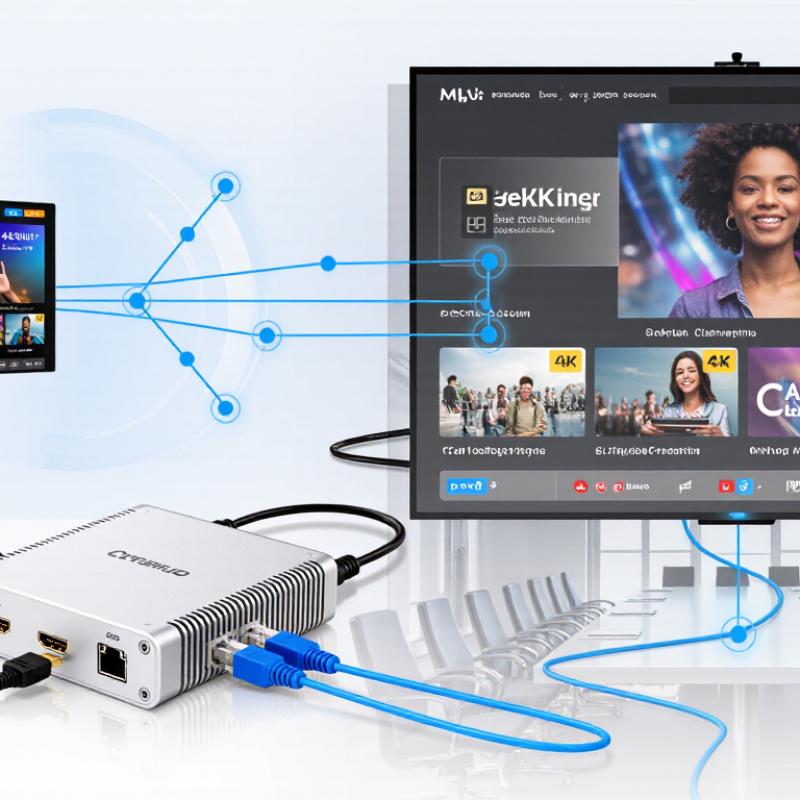
| HDMI over IP | About 100 m per copper network link is common with suitable Ethernet infrastructure; total distance can be much greater through network design | May support HD, 4K, or compressed video, depending on encoder, decoder, network capacity, and latency requirements | Cat 5e, Cat 6, Cat 6A, fiber, switches, or a dedicated network | Encoders, decoders, and network switches normally require external power | Multi-display distribution, scalable digital signage, and centrally managed AV systems | Evaluate bandwidth, multicast support, latency, compression, network isolation, synchronization, and cybersecurity. A standard office network may not be suitable without configuration |
| Important: The distances shown are typical planning ranges, not guaranteed results. Actual performance depends on resolution, refresh rate, color depth, chroma subsampling, HDR, HDCP, cable quality, connector transitions, electrical interference, and the specifications of every connected device. |



 08045479132
 Send Inquiry

 Send Inquiry
 Send SMS